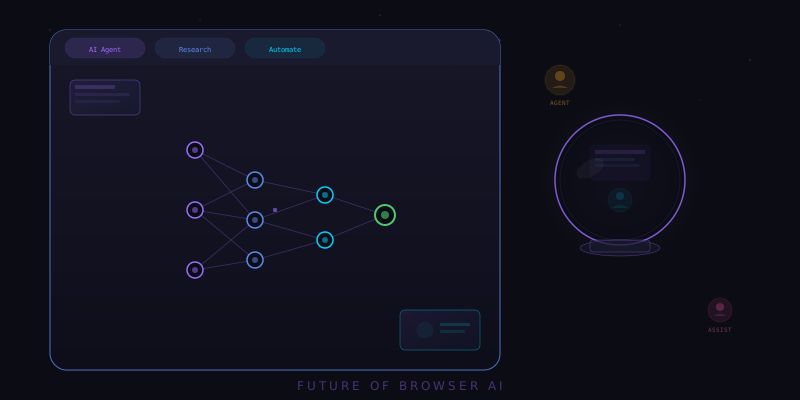
The Browser Is Becoming the Operating System
For decades, the operating system was the platform that mattered. Applications were installed locally, data lived on your hard drive, and the browser was just another app in the dock. That model has been quietly inverting for years, and AI is accelerating the shift to its logical conclusion. Today, most knowledge work happens inside the browser: email, documents, project management, communication, design, analytics, and increasingly, development. The browser is no longer a window into the internet; it is the workspace itself.
Tensor is built on this conviction. If the browser is where you spend your working hours, then the browser is where AI should meet you. Not in a separate app that requires context-switching. Not in an API that requires programming. Not in a chatbot that cannot see what you are looking at. The AI should live inside the browser, see what you see, and act where you act. This is the fundamental architectural bet behind Tensor, and it is where the entire industry is heading.
Persistent Agents as Digital Workers
The first wave of browser AI was conversational: you ask a question, you get an answer. The second wave, which Tensor pioneered, is agentic: you give a task, and an AI agent executes it by navigating pages, clicking buttons, filling forms, and reading content. The third wave, which we are building toward, is persistent: agents that run continuously, handle recurring responsibilities, and manage ongoing workflows without any human triggering.
Think of persistent agents as digital workers who show up every day and do their jobs. A persistent agent monitoring your competitor's pricing page does not wait for you to ask about pricing changes. It checks on its own schedule, notices changes, evaluates their significance, and reports to you only when action is needed. Another persistent agent manages your social media monitoring, reading mentions, flagging negative sentiment, and drafting response suggestions before you even open Twitter.
This shift from reactive to proactive AI is the most consequential change in how humans interact with software since the graphical user interface. Instead of you operating tools, tools operate themselves under your oversight. Your role shifts from executor to manager, and your capacity multiplies by the number of agents you deploy.
The Marketplace as an App Store
Native app stores transformed mobile computing by giving every developer a distribution channel and every user a discovery mechanism. Tensor's Agent Marketplace is building the same dynamic for browser AI. Instead of installing apps, you install agents. Instead of opening an app to use its functionality, you tell an agent what to do and it handles the rest.
The marketplace already hosts hundreds of community-built agents covering SEO auditing, data extraction, form filling, price monitoring, content generation, and dozens of other workflows. But we are still in the early days. The potential space of useful agents is enormous because every repetitive browser task is a candidate for automation.
Looking ahead, we envision the marketplace evolving in several directions. Agent composability will allow you to chain multiple agents together into complex workflows, where the output of one agent feeds into the input of another. An agent rating and review system will help surface the highest-quality agents while encouraging developers to iterate and improve. Revenue sharing will allow agent builders to monetize their creations, creating an economic incentive for the community to build increasingly sophisticated and specialized tools.
Why the Browser Is the Right Platform for AI
Several properties make the browser uniquely suited as an AI platform, and these advantages will only compound as the technology matures:
- Universal access: The browser can reach any website, any web application, and any cloud service. An AI agent in the browser can interact with your email, your project management tool, your CRM, your analytics dashboard, and any other web-based system, all from a single integration point.
- Visual context: The browser renders web pages visually, giving AI agents the same rich context that humans have. An agent can see a button, read its label, understand its position relative to other elements, and decide whether to click it. This visual understanding is far more robust than API-based integrations that break whenever a service changes its data format.
- No API dependency: Most web services do not offer public APIs, and those that do often restrict functionality or charge premium prices. Browser-based AI agents interact with services through their web interfaces, the same way users do, requiring no API access, no authentication tokens, and no technical setup.
- Cross-platform by default: A browser extension works on Windows, Mac, Linux, and ChromeOS. There is no need to build separate native applications for each platform. One codebase reaches every desktop user.
- Privacy-preserving architecture: Because Tensor runs locally as a browser extension, your data stays on your device. There is no server-side processing of your browsing activity, no cloud storage of your personal information, and no third-party data sharing. This is architecturally impossible to achieve with cloud-based AI services that require sending your data to remote servers.
What Is Coming in Tensor 3.0
We are actively building the next major version of Tensor, and while I cannot share every detail, I can outline the themes that define our roadmap:
Agent memory and learning. Currently, agents execute tasks based on your instructions and forget everything when the task is complete. Tensor 3.0 introduces persistent memory that lets agents learn from past interactions. An agent that has filled out job applications for you before will remember which fields typically need manual correction and get better over time. An agent that monitors prices will learn which price drops are genuine deals versus temporary fluctuations.
Multi-agent collaboration. Today, agent swarms execute parallel tasks independently. In Tensor 3.0, agents will be able to communicate with each other during execution. A research agent that discovers an important finding can alert a monitoring agent to start tracking that topic. A data extraction agent can pass its output directly to an analysis agent without human intermediation.
Natural language agent creation. Building custom agents currently requires describing what you want in the chat and configuring options. Tensor 3.0 will introduce a visual agent builder where you demonstrate a workflow by performing it once, and Tensor automatically creates a reusable agent that replicates your actions. Show it how to check your portfolio performance on three different sites, and it creates a persistent agent that does this check every morning.
Deeper browser integration. We are exploring integration points beyond the sidepanel: inline suggestions that appear next to form fields, contextual actions that appear when you select text, smart tab management that groups and organizes tabs based on your current task, and ambient awareness that understands your workflow context without explicit instructions.
The Bigger Picture
I started building Tensor because I believed the browser was the most underutilized platform in computing. Billions of people use browsers every day, spending hours navigating, reading, typing, clicking, and waiting. Most of that interaction is manual, repetitive, and could be automated. The technology to automate it, large language models with visual understanding and tool-use capabilities, finally exists. The platform to deploy it, the browser extension ecosystem, is mature and accessible. The demand from users who are tired of digital busywork is enormous.
What excites me most about the future is not any single feature or capability. It is the compounding effect of an ecosystem. Every new agent in the marketplace makes Tensor more valuable for every user. Every new user provides feedback that makes every agent better. Every workflow that gets automated frees up human time for the creative, strategic, and interpersonal work that AI cannot and should not replace. The browser becomes smarter every day, and so does everyone who uses it.
We are building the infrastructure for a world where your browser works as hard as you do, and where the boundary between using the web and commanding it disappears entirely. That future is closer than you think.