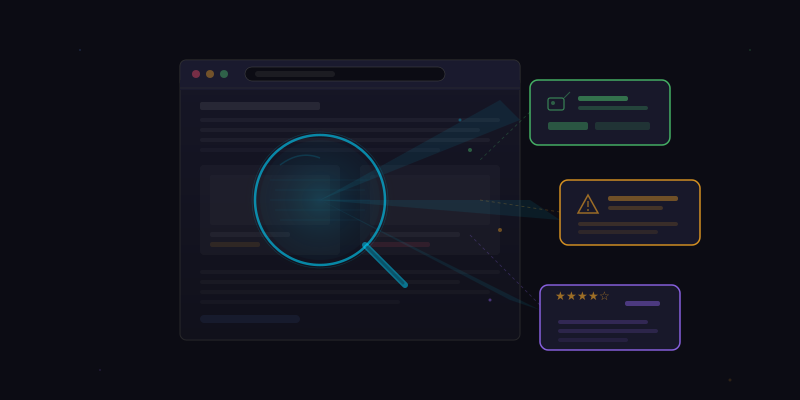
Every browser AI today follows the same playbook: wait for the user to ask a question, then scramble to understand what they are looking at. It is fundamentally reactive. Tensor flips that model. The moment you land on any page, our intent engine has already classified it, extracted the relevant context, and prepared a set of insights you might want. The result is an AI assistant that feels less like a chatbot and more like a colleague who already read the memo before the meeting started.
The Classification Pipeline
At the heart of Tensor's proactive intelligence is a lightweight classification pipeline that runs within milliseconds of page load. The engine does not rely on URL patterns alone, because a URL tells you almost nothing about what a page actually contains. Instead, it analyzes a combination of DOM structure, semantic landmarks, meta tags, structured data, and visual hierarchy to determine the page type with high confidence.
The classifier currently recognizes over twenty distinct page types, but the most impactful ones fall into a few core categories:
- Product pages — detected via price elements, add-to-cart buttons, product schema, review sections, and image galleries
- Articles and blog posts — identified by article tags, bylines, published dates, reading progress indicators, and long-form text blocks
- Checkout and payment flows — recognized through form fields for shipping and billing, payment method selectors, order summaries, and progress steppers
- Forms and applications — classified by input density, fieldset grouping, submit buttons, and multi-step wizard patterns
- Search results — detected via repeated item structures, pagination, filter sidebars, and sort controls
- Dashboards — identified by chart containers, data tables, metric cards, and navigation sidebars
Each classification comes with a confidence score. When the score exceeds the threshold, Tensor activates the corresponding context extraction module without any user interaction.
Context Extraction: Going Beyond Surface Data
Classification alone is not enough. Once Tensor knows what kind of page you are on, it needs to extract the specific information that matters. On a product page, that means pulling the product name, current price, original price (if discounted), rating, review count, availability status, shipping estimates, and seller information. On an article, it means extracting the title, author, publication date, estimated reading time, key topics, and a brief summary.
The extraction layer uses a combination of CSS selectors, ARIA attributes, JSON-LD structured data, Open Graph meta tags, and a small language model that can parse unstructured text when the page does not follow any standard patterns. This multi-layered approach means Tensor can handle everything from a perfectly marked-up Shopify store to a custom-coded marketplace with no semantic HTML whatsoever.
// Simplified extraction pipeline
const context = await intentEngine.analyze(document);
// Returns:
// {
//   pageType: "product",
//   confidence: 0.97,
//   data: {
//     name: "Sony WH-1000XM5",
//     price: 348.00,
//     originalPrice: 399.99,
//     rating: 4.7,
//     reviewCount: 12847,
//     inStock: true,
//     seller: "Amazon.com"
//   },
//   insights: [ ... ],
//   warnings: [ ... ]
// }
The extracted data is immediately available in Tensor's context window. This means that when you do ask a question, the AI already has all the facts. There is no parsing delay, no hallucination about prices, and no confusion about which product you are looking at.
Surfacing Insights Automatically
Extraction feeds into the insight engine. Each page type has a set of insight generators that look for patterns, anomalies, and opportunities in the extracted data. On a product page, for example, Tensor automatically checks price history databases, compares the current price against historical averages, identifies whether the product is at its lowest price, and surfaces alternative listings from other retailers.
On article pages, the insight engine generates a three-sentence summary, estimates reading difficulty, identifies the key arguments, and flags any claims that appear unsupported. For search results, it highlights the best match based on your preferences and past behavior, and surfaces any results that seem artificially boosted.
These insights appear in Tensor's sidebar as small, unobtrusive cards. They do not interrupt your workflow. You can glance at them when convenient, expand them for more detail, or ignore them entirely. The system learns from your engagement: if you consistently dismiss product price comparisons but always expand article summaries, Tensor adapts its insight priority accordingly.
Dark Pattern Detection on Checkout Pages
Perhaps the most important application of the intent engine is dark pattern detection on checkout and subscription pages. When Tensor classifies a page as a checkout flow, it activates a specialized scanner that looks for manipulative design practices. These patterns are not just annoying; they cost consumers billions of dollars annually through unwanted subscriptions, hidden fees, and coerced upsells.
The scanner checks for the following categories:
- Sneak into basket — items added to your cart that you did not select, such as warranties, insurance, or complementary products pre-checked by default
- Hidden costs — fees that only appear at the final checkout step, including service charges, handling fees, or mandatory tips
- Forced continuity — free trials that auto-convert to paid subscriptions with no clear cancellation path
- Confirmshaming — decline options worded to make you feel guilty, like "No thanks, I don't want to save money"
- Urgency manipulation — fake countdown timers, false scarcity claims ("Only 2 left!"), and pressure language
- Misdirection — visual hierarchy that draws attention to the more expensive option or makes the cancel button hard to find
When Tensor detects a dark pattern, it highlights the offending element with a visible orange outline directly on the page and displays a clear explanation of what the pattern is doing and why it might be harmful. For pre-checked add-ons, Tensor can automatically uncheck them with a single click. For hidden fees, it recalculates the true total and displays it prominently.
// Dark pattern detection result
{
  type: "sneak_into_basket",
  element: "#warranty-checkbox",
  severity: "high",
  description: "A $29.99 extended warranty was pre-selected",
  action: "uncheck",
  savings: 29.99
}
Privacy and Performance
A legitimate concern with any system that analyzes every page you visit is privacy. Tensor's intent engine runs entirely on-device. No page content, extracted data, or classification results are ever sent to external servers. The classification model is a compact neural network under two megabytes that runs in a dedicated Web Worker, keeping the main thread free and ensuring zero impact on page performance.
We benchmark the full pipeline, from page load to insight generation, at under 150 milliseconds on average hardware. That includes DOM traversal, structured data extraction, classification inference, and insight generation. On pages with heavy JavaScript, the engine waits for the meaningful content to render before analyzing, using a combination of MutationObserver and requestIdleCallback to avoid competing with the page's own scripts.
The Future: Cross-Page Intelligence
The current intent engine operates on individual pages. The next evolution is cross-page intelligence, where Tensor maintains context across your entire browsing session. Imagine researching laptops across five different retailer sites: Tensor would automatically build a comparison table, track price differences, highlight specification discrepancies, and flag reviews that seem inauthentic, all without you opening a single spreadsheet.
We are also experimenting with predictive intent, where the engine anticipates what you are going to do next based on your current page and browsing pattern. If you are reading a recipe, Tensor might pre-fetch nutritional information and suggest a grocery list. If you are comparing flight prices, it might monitor those flights for price drops over the next 48 hours.
Proactive intelligence is not about making decisions for the user. It is about making sure the user always has the information they need, right when they need it, without having to ask.
Experience Proactive Intelligence
Download Tensor and let your browser start working for you.
Download Tensor