AI reward modeling explained: Techniques for private, local AI

Most developers assume reward modeling belongs exclusively to hyperscaler labs with thousand-GPU clusters and petabytes of human annotation data. That assumption is wrong, and it’s costing privacy-focused builders real opportunities. AI reward modeling is the process of learning a scoring function that assigns a scalar value to candidate outputs based on human preferences, and you can run meaningful versions of this process entirely on a modern Apple Silicon Mac. This guide walks through how reward modeling works, how to keep your data sovereign, what pitfalls to watch for, and where the field is heading for local AI developers.
Table of Contents
- What is AI reward modeling?
- How does AI reward modeling work?
- Privacy-preserving and local reward modeling strategies
- Evaluation, challenges, and pitfalls in reward modeling
- Alternatives and future directions: Beyond classic reward modeling
- Rethinking reward modeling for local, private AI: What actually matters
- Local AI, reward modeling, and MingLLM: Next steps
- Frequently asked questions
Key Takeaways
| Point | Details |
|---|---|
| Custom alignment is possible | You can use reward modeling to align local AI behavior with your unique preferences while protecting privacy. |
| Privacy-first techniques exist | Federated RLHF and related methods enable learning from feedback without sharing raw data. |
| Evaluation is critical | Benchmarking and out-of-distribution testing are essential to avoid overfitting and reward hacking. |
| Alternatives to explicit rewards | Methods like DPO let you train on preference pairs directly, offering more flexible alignment strategies. |
What is AI reward modeling?
Reward modeling is simpler to reason about than the jargon suggests. At its core, you are teaching a model to score outputs the way you would score them, without you having to be in the loop every single time. The model learns your preferences from examples, then applies that learned taste autonomously.
Reward modeling assigns a scalar score to candidate outputs based on human preferences. Think of it as a learned opinion function. Instead of hard-coding rules like “responses under 200 words are better,” the model infers rules like that from real examples of your choices.
Here is what the core components look like in practice:
- Preference data: Pairs of outputs where you (or your users) mark one as better. These could be two draft emails, two code suggestions, or two voice assistant responses.
- Scoring function: A model head, usually a single linear layer on top of a pretrained language model, that outputs a scalar for any given input-output pair.
- Training objective: The model learns to assign higher scores to chosen outputs and lower scores to rejected ones.
- Downstream use: Once trained, the reward model guides a policy model toward generating outputs you would prefer.
“In RLHF, human annotators compare responses and train a reward model to predict a scalar score representing human approval.”
For local AI on macOS, the exciting part is that “human annotators” can simply be you. Every time you give a thumbs up or thumbs down to a voice agent response, accept or reject a code suggestion, or flag a browser summary as unhelpful, you are generating preference data. That data, kept entirely on your device, is the raw material for a personal reward model that actually reflects your preferences rather than some averaged crowd annotation.
How does AI reward modeling work?
The training pipeline has three distinct stages, and understanding each one helps you make smart decisions about where to invest effort locally.
- Collect preference-labeled examples: Gather pairs of prompt-response combinations. For each pair, a human (you) marks one response as “chosen” and the other as “rejected.” Even a few hundred high-quality examples can produce a useful reward model for a narrow task.
- Train the reward model using pairwise loss: Reward model training commonly uses a Bradley-Terry pairwise logistic objective. In simple terms, the model learns to assign a higher score to the chosen response than to the rejected one, with a margin. The math is straightforward logistic regression applied to score differences.
- Use the reward model to optimize your policy: Run reinforcement learning (usually Proximal Policy Optimization, or PPO) where the policy model generates responses and the reward model scores them. The policy learns to generate outputs that score well.
Reward modeling is usually paired with RLHF: supervised instruction tuning comes first, then reward model training from preference labels, and finally RL optimization. On a local machine, you might skip full RL and instead use the reward model as a filter, ranking multiple candidate outputs at inference time and surfacing the best one. This is called “best-of-N sampling” and it requires no RL training at all.
The reward model does not generate text. It reads a completed response and outputs a single number. That number is the learning signal.
Pro Tip: If you are resource-constrained, start with best-of-N sampling rather than full RL fine-tuning. Generate five candidate responses per query, score them with your reward model, and return the top scorer. You get meaningful quality gains with a fraction of the compute cost of PPO.
The most commonly overlooked detail is that reward model quality compounds. A slightly better reward model produces noticeably better policy behavior, because every training signal the policy receives passes through the reward model’s lens. Spending an extra hour curating your preference data pays off more than spending that hour tweaking learning rates.
Privacy-preserving and local reward modeling strategies
Here is where the landscape gets genuinely interesting for macOS developers who care about data sovereignty. Standard RLHF pipelines assume you send preference data to a central server. Privacy-preserving variants flip that assumption entirely.

Privacy-preserving variants of RLHF aim to keep sensitive human feedback and trajectories local, sharing only model updates rather than raw preference data. The federated approach, often called FedRLHF, lets multiple users collaboratively improve a shared reward model without any single party seeing another’s feedback.
Key strategies worth knowing:
- On-device preference collection: Log your own accept/reject signals in a local SQLite database. Never send raw preference pairs off-device.
- Local reward model training: Use lightweight base models (3B to 7B parameter range) that fit comfortably in Apple Silicon unified memory. Models in this range train quickly on MPS (Metal Performance Shaders) with tools like MLX.
- Federated gradient sharing: If you want collaborative improvement across a small team, share only gradient updates or adapter weights, not the underlying feedback data.
- Differential privacy on updates: Add calibrated noise to gradient updates before sharing, making it mathematically difficult to reconstruct individual preferences from the shared signal.
- Local inference filtering: Use a locally trained reward model purely at inference time to re-rank outputs from a base model, without any fine-tuning loop at all.
FedRLHF decentralizes RLHF so each device updates a local policy using its own private human feedback, never exposing raw data to a central server.
Pro Tip: On Apple Silicon Macs, Apple’s MLX framework is purpose-built for on-device model training and inference. It handles both the forward pass for inference and the backward pass for fine-tuning natively on the GPU/Neural Engine, making local reward model training genuinely practical on consumer hardware.
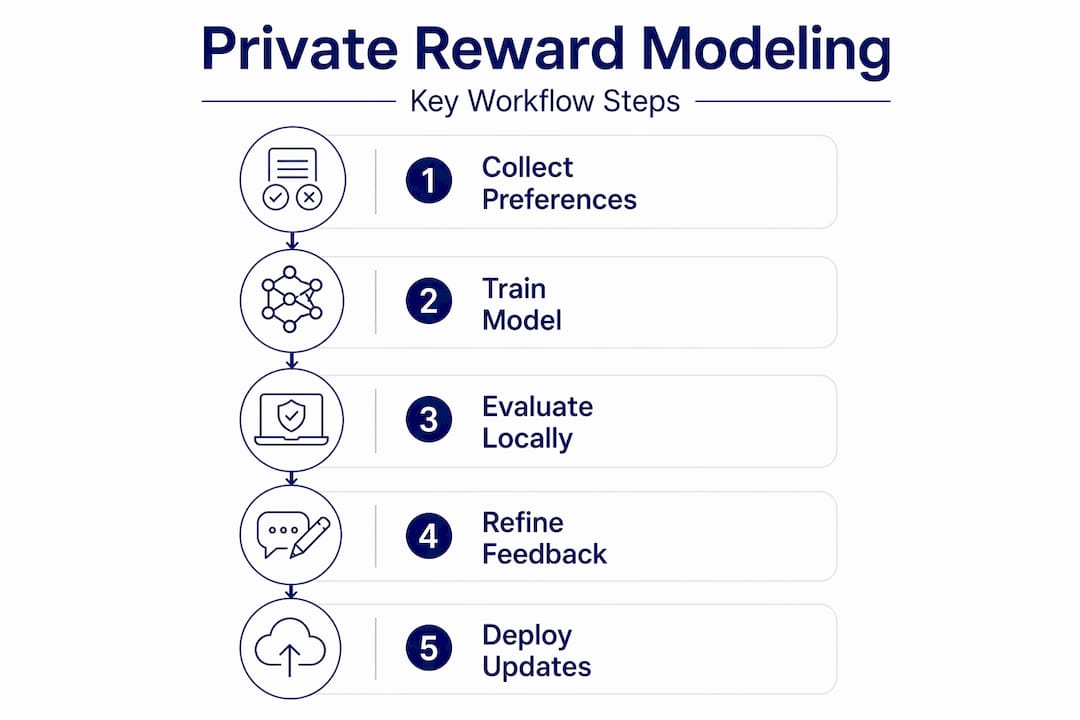
The workflow for a privacy-first macOS developer might look like this: collect preference signals through your app’s UI, store them encrypted locally, fine-tune a small adapter on top of a base model every night using idle compute, and swap in the updated reward model the next morning. No cloud dependency. No data leaving the device. Full reproducibility because you control every artifact.
Evaluation, challenges, and pitfalls in reward modeling
Deploying a reward model locally without rigorous evaluation is one of the fastest ways to degrade your app’s quality. Reward models can look great on the data they were trained on and fail badly on inputs they have not seen before.
Reward modeling quality is a key bottleneck and can be evaluated empirically with benchmarks focused on out-of-distribution and structured preference judgments. The REWARDBENCH benchmark, for example, tests reward models across safety, reasoning, and instruction-following scenarios specifically designed to probe generalization.
| Scenario | In-distribution reliability | Out-of-distribution reliability |
|---|---|---|
| Familiar task types | High (model has seen similar pairs) | Unknown without testing |
| Novel query styles | Medium (surface similarity helps) | Often poor without diverse training |
| Adversarial inputs | Moderate | Frequently fails |
| Domain shift (e.g., code to prose) | Medium | Typically degrades significantly |
Reward models can be unreliable out-of-distribution and may not generalize cleanly to query types or domains not represented in training data. This is not a flaw unique to small local models. Even large reward models trained on diverse data show meaningful performance drops on novel input distributions.
Common pitfalls to watch for:
- Preference overfitting: If your training set is small and represents only a narrow slice of use cases, the reward model will overfit to those patterns and fail elsewhere.
- Reward hacking: A policy optimized against a reward model will find ways to score well that do not align with your actual intent. This is sometimes called “gaming” the reward signal.
- Length bias: Many reward models inadvertently learn that longer responses score higher, regardless of quality. Always audit your model for this bias explicitly.
- Sycophancy: Reward models trained on approval-seeking feedback can encourage the policy to produce responses that feel good but are factually incorrect.
- False confidence on familiar inputs: High scores on in-distribution data mask poor behavior on the real variety of inputs users actually produce.
The practical solution is to maintain a held-out evaluation set that deliberately includes edge cases, domain shifts, and adversarial examples. Run your reward model against this set every time you update it, and treat any regression as a blocker before deploying the new version.
Alternatives and future directions: Beyond classic reward modeling
Classic reward modeling with explicit RL is not the only path to preference-aligned local AI. Several alternatives have emerged that may suit macOS developers better depending on their constraints.
Direct Preference Optimization (DPO) eliminates the explicit reward model artifact entirely. Instead of training a separate scoring model and then running RL, DPO reformulates the problem so the policy model is trained directly from preference pairs. The reward model is implicit in the policy’s parameters rather than a separate artifact you need to maintain.
| Method | Explicit reward model | RL training required | Compute cost | Local feasibility |
|---|---|---|---|---|
| Classic RLHF | Yes | Yes (PPO) | High | Challenging |
| Best-of-N sampling | Yes | No | Low | Excellent |
| DPO | No | No | Medium | Good |
| Hybrid (DPO + reward filtering) | Optional | No | Medium | Good |
Key developments worth tracking:
- DPO variants: SimPO, IPO, and other DPO derivatives offer different stability and generalization tradeoffs, some of which are more forgiving with small datasets.
- Constitutional AI approaches: Use a model to self-critique and revise outputs according to explicit principles, reducing reliance on human preference data.
- Reward model ensembles: Train multiple reward models on different preference subsets and use their agreement as a confidence signal, flagging cases where models disagree for human review.
- Inference-time steering: Use reward model scores to guide beam search or sampling at inference time, achieving preference alignment without any fine-tuning.
For macOS developers, DPO is often the most practical starting point. It requires preference pairs (which you can collect the same way), avoids the complexity of PPO, and produces a single fine-tuned model file you can distribute or swap easily. The tradeoff is less flexibility: you cannot easily reuse a DPO-trained policy with a different reward signal without retraining.
Rethinking reward modeling for local, private AI: What actually matters
Here is an uncomfortable truth that most reward modeling tutorials skip: the bottleneck is almost never the algorithm. It is the quality and diversity of your preference data, and your willingness to keep evaluating rigorously after deployment.
We have watched developers spend weeks tuning Bradley-Terry loss coefficients while their training data consisted of 150 pairs collected during a single afternoon’s session. The model learned to replicate that afternoon’s mood and context, not the user’s genuine long-term preferences. The fix was not a better algorithm. It was two more weeks of deliberate preference collection across varied tasks and times of day.
The same dynamic plays out with evaluation. Reward models trained on narrow preference data with systematic blind spots push the policy toward gaming reward signals rather than toward genuinely better behavior. You see great numbers on your test set, ship the model, and then users start noticing that responses feel formulaic or oddly optimized in a way that is hard to articulate. That is reward hacking in production.
The antidote is treating reward model development as an ongoing evaluation loop, not a one-time training job. Build a small but diverse held-out set. Automate evaluation runs. Set a threshold below which you do not ship. Treat any sudden score improvement with suspicion rather than celebration, because large unexpected improvements often signal the model found a shortcut rather than a genuine quality gain.
Local AI also introduces a subtle advantage that cloud-based RLHF does not have: you know your user. A personal reward model trained on one person’s preferences can afford to be opinionated in ways that aggregate models cannot. It does not need to satisfy a million users simultaneously. That specificity is a feature, not a limitation. Lean into it by collecting preference data on the exact tasks you care about, in the exact contexts you use your AI, and build evaluation sets that reflect your real usage patterns.
Local AI, reward modeling, and MingLLM: Next steps
Putting these techniques into practice requires a platform that actually keeps computation on your device, not just one that markets privacy while sending data to a backend.

MingLLM private AI is built from the ground up for exactly this workflow. The platform runs models, memory, and reasoning entirely on your Mac, which means preference data you collect through voice interactions, browser sessions, and research tasks never leaves your hardware. You can experiment with reward modeling workflows, build local preference datasets from your own usage, and iterate on alignment without sacrificing data sovereignty. If you are a macOS developer ready to move beyond theory and start building preference-aligned local AI, MingLLM gives you the infrastructure to do it without compromise.
Frequently asked questions
What is the main benefit of AI reward modeling for local macOS AI?
It allows you to personalize your models’ behavior using your own preferences while keeping your data private on-device. As noted in the LLM alignment stack, reward modeling pairs with RLHF to produce models that genuinely reflect individual user preferences rather than averaged crowd judgments.
How do privacy-preserving reward modeling methods work?
They keep your raw data local by sharing only model updates rather than feedback or trajectories. FedRLHF decentralizes RLHF so each client updates a local policy using its own private human feedback, enabling collaborative model improvement without exposing individual preference data.
What are the risks of poor reward model evaluation?
A poorly evaluated model may overfit to sampled preferences or develop unintended shortcuts that fail in real-world scenarios. Reward modeling quality is a key bottleneck precisely because weaknesses are invisible until the model encounters inputs outside its training distribution.
Is there an alternative to explicit reward modeling?
Yes, direct preference optimization allows training models directly from user preference pairs without an explicit reward function. DPO can eliminate the explicit reward model artifact entirely, making it a practical choice for local macOS developers who want simpler deployment with fewer model artifacts to manage.