How to Test Local AI Agent Capabilities in 2026

Testing local AI agent capabilities means verifying functional performance, reliability, and safety directly on your device without cloud dependencies or data exposure. The industry term for this practice is local agent evaluation, and it covers everything from trajectory scoring to governance oversight. Tools like AgentProbe, Prism, and LangSmith make it possible to run rigorous, multi-dimensional assessments entirely on your own hardware. The privacy advantage is real: your prompts, tool calls, and reasoning traces never leave your machine. This guide walks you through the prerequisites, the step-by-step process, and the troubleshooting methods that separate a solid local evaluation from one that gives you false confidence.
What you need to test local AI agent capabilities
Before you run a single evaluation, your hardware and software stack need to be ready. Running local LLMs and agents smoothly requires at minimum 16GB of RAM, though 32GB is the practical floor for multi-step agents using tool calls. An Apple Silicon Mac (M2 or later) or a machine with a dedicated GPU handles inference fast enough to make latency measurements meaningful. Without adequate hardware, your benchmarks reflect resource contention, not agent quality.
Software frameworks and local evaluation tools
The software layer is where most setups fall short. You need at least one inference runtime, one orchestration framework, and one evaluation harness. Ollama handles local model serving with a clean API. LangChain or a lightweight alternative provides the agent loop. For evaluation, AgentProbe and AgentEvalHarness offer CI/CD integration and local dashboards, making regression testing repeatable without sending data to an external service.

| Tool | Primary function | Data privacy | CI/CD support | Key metric |
|---|---|---|---|---|
| AgentProbe | Regression and unit testing | Fully local | Yes | Pass/fail per task |
| AgentEvalHarness | Multi-step suite runner | Fully local | Yes | Trajectory score |
| Prism | Governance and oversight | Fully local | Partial | Tool call approval rate |
| LangSmith | Offline + online lifecycle | Configurable | Yes | LLM-as-judge scores |
| AWS Bedrock AgentCore | Hybrid cloud-local evaluation | Hybrid | Yes | End-to-end task success |
Preparing your evaluation dataset is as important as picking the right tool. Your test cases should mirror real tasks the agent will handle in production: file reads, web lookups, multi-turn dialogs, and error recovery scenarios. A dataset built from synthetic edge cases alone produces scores that collapse the moment the agent touches real workloads.
Pro Tip: Pin your model version and random seed before every evaluation run. Stochastic variance between runs makes it impossible to tell whether a score change reflects a real improvement or just sampling noise.
How to run a structured local agent evaluation
A repeatable evaluation process follows six steps. Skipping any one of them produces gaps that surface as production failures later.
-
Define your task contract and metrics upfront. Specify what success looks like for each task, the acceptable failure cost, and the metrics you will track: trajectory score, hallucination rate, latency at P99, and tool use accuracy. Unclear success metrics are the leading cause of evaluation failures, so write these down before touching any code.
-
Instrument your agent with tracing. Every model call, tool invocation, argument, and output state needs to be logged. Full trace logging is the only way to run regression tests and diagnose intermittent errors. Without it, you are debugging blindfolded.
-
Configure governance oversight. Integrate a local oversight SDK like Prism, which runs fully on-machine, logs all tool calls for traceability, and pauses execution pending human approval for write, send, or delete actions. This step is non-negotiable if your agent touches the filesystem or external APIs during testing.
-
Run single-step and multi-step evaluations. Start with isolated unit tests for individual tool calls, then graduate to full trajectory runs using AgentEvalHarness or LangSmith’s pytest integration. LangSmith supports both pre-deployment benchmarking and LLM-as-judge scoring for nuanced output quality checks.
-
Collect and review trace logs. Pull the full trace for every failed run. Look at intermediate reasoning steps, not just the final output. A 95% per-step success rate over 8 sequential steps yields only about 66% task completion due to error compounding. That math makes trajectory-level review mandatory, not optional.
-
Iterate on test cases and agent configuration. Update your evaluation dataset with cases that exposed failures. Adjust thresholds, fix tool interfaces, and rerun. The goal is a test suite that gets harder over time, not one that the agent memorizes.
Pro Tip: After each full evaluation cycle, export your trace logs and tag the runs with the model version and configuration hash. This creates an audit trail that makes A/B comparisons between agent versions precise and fast.
Common pitfalls when evaluating local AI agents
Local agent evaluation breaks down in predictable ways. Knowing the failure modes in advance saves hours of debugging.
-
Relying on aggregate scores. A single pass/fail percentage hides the breakdown between task completion, error recovery, and tool accuracy. Set per-dimension thresholds and gate your CI pipeline on each one separately. A high final-task completion score paired with low error recovery will cause production failures.
-
Ignoring non-determinism. Local models produce different outputs across runs unless you pin seeds. Borderline test cases that flip between pass and fail on repeated runs need to be rerun at least five times and scored by majority result.
-
Incomplete governance coverage. Agents that call tools without oversight create risk even in test environments. Consequential oversight, where actions with real-world effects are explicitly gated and audited locally before execution, prevents accidental writes or deletions during evaluation runs.
-
Overfitting to narrow benchmarks. If your test set covers only the happy path, your scores are meaningless. Include adversarial inputs, malformed tool responses, and mid-task interruptions to measure actual robustness.
“Most evaluation failures come from unclear success metrics and ignoring operating budget or risk boundaries. Defining these anchors upfront is critical.” — How to Evaluate Agentic Systems
Professional deployment standards set the bar at less than 2% hallucination rate and 99.5% availability under peak loads for regulated AI agents. Tracking your local results against these benchmarks gives you a concrete target rather than a vague sense of “good enough.”
Comparing local AI evaluation frameworks and observability tools
Choosing the right framework depends on your priorities: speed of setup, depth of tracing, governance requirements, or CI integration.
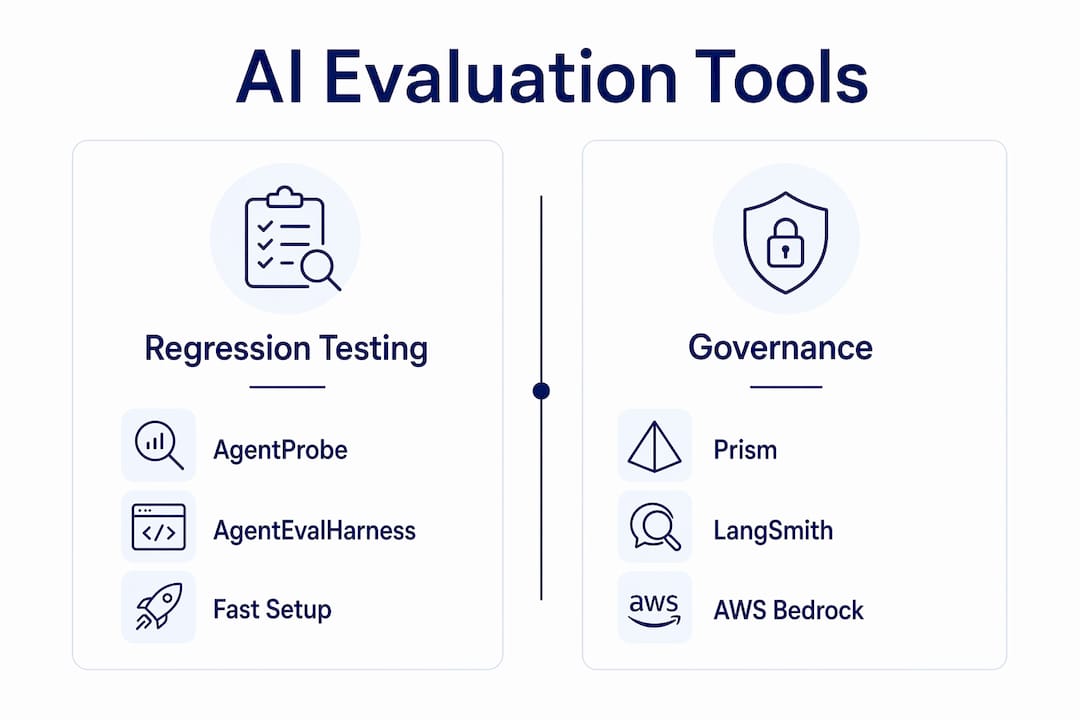
AgentProbe and AgentEvalHarness are the fastest path to regression testing. Both run locally, expose dashboards on configurable ports, and integrate with standard CI pipelines. AgentProbe focuses on unit-level task assertions. AgentEvalHarness handles multi-step trajectory runs with configurable scoring rubrics. Neither requires an external account or API key, which keeps your evaluation data entirely on-device.
Prism fills the governance gap that pure evaluation tools leave open. It intercepts tool calls at runtime, logs every argument and return value, and surfaces a human approval prompt for any action classified as risky. For developers building agents that touch real files or send messages, Prism is the difference between a safe test environment and one that can cause real damage.
LangSmith offers the most mature lifecycle management. Its offline mode uses pytest fixtures and LLM-as-judge scoring to evaluate both single-step responses and full multi-turn conversations. The tradeoff is that full observability features push data to LangChain’s servers unless you self-host, so review your configuration before using it with sensitive workloads.
AWS Bedrock AgentCore takes a hybrid approach, running evaluation logic locally while optionally syncing results to AWS for team-wide visibility. It suits teams that need local privacy during development but centralized reporting for stakeholders.
For AI output validation across all these tools, the consistent recommendation is to validate structured outputs against a schema on every run, not just spot-check them manually. Schema validation catches silent regressions that pass human review but break downstream consumers.
When you need to track agent reliability over time, pairing your local evaluation suite with production data quality monitoring gives you a feedback loop between what you test offline and what actually fails in use.
Key takeaways
Effective local AI agent evaluation requires trajectory-level metrics, full trace logging, and per-dimension CI gates to catch failure modes that aggregate scores consistently miss.
| Point | Details |
|---|---|
| Trajectory scoring is mandatory | A 95% per-step success rate over 8 steps yields only 66% task completion due to error compounding. |
| Full trace logging enables regression testing | Logging only final outputs makes it impossible to diagnose intermittent failures or run meaningful comparisons. |
| Governance oversight prevents test-time damage | Tools like Prism gate risky tool calls locally, preventing accidental writes or deletions during evaluation. |
| Per-dimension CI gates beat aggregate scores | Gate pipelines on error recovery, tool accuracy, and plan coherence separately to catch production failure patterns early. |
| Production feedback closes the loop | Embedding real failure cases into offline test sets reduces hotfixes and improves long-term agent reliability. |
Why trajectory evaluation changed how I think about local testing
I spent months running local agent evaluations that looked great on paper and fell apart in practice. The turning point was switching from final-output scoring to full trajectory review. Once I could see every intermediate reasoning step and tool call in a trace log, the failure modes became obvious: the agent was recovering from errors in ways that technically completed the task but produced outputs no human would accept.
The uncomfortable truth about local AI agent testing is that most developers stop at “did it finish?” That question is necessary but nowhere near sufficient. Production feedback loops that feed real failures back into offline test sets are what separate agents that hold up in production from ones that require constant patching.
Governance oversight is the other piece most local setups skip. Running Prism during evaluation runs felt like overhead at first. Then I watched a test agent delete a config file it was only supposed to read. Human-in-the-loop approvals for consequential actions are not a nice-to-have. They are the mechanism that keeps local testing from becoming local damage.
My practical advice: build your test suite to get harder every sprint, not easier. Every production failure is a test case you did not write yet. Write it immediately, add it to your harness, and set a threshold that would have caught it. That discipline compounds faster than any model upgrade.
— steve
Start evaluating your local AI agents with Mingllm
If you are ready to move from ad hoc testing to a structured local evaluation practice, Mingllm is built for exactly that workflow.

Mingllm runs entirely on your device, with detailed action logs and proof traces that give you the transparency trajectory evaluation demands. The platform’s local-first architecture means your test data, trace logs, and agent configurations stay on your hardware. Whether you are assessing a voice agent, a browser automation agent, or a multi-step research pipeline, Mingllm’s evaluation resources give you the frameworks and community support to do it right. Explore the tools, contribute your test cases, and connect with other developers building serious local AI workflows.
FAQ
What is trajectory scoring in local AI agent evaluation?
Trajectory scoring measures agent performance across every step of a task, not just the final output. It breaks down planning efficiency, tool use quality, error recovery, and instruction adherence to reveal failure modes that final-output scores hide.
How do I reduce non-determinism when I test AI capabilities locally?
Pin your model version and random seed before each run, and rerun any borderline test cases at least five times. Score borderline results by majority outcome to filter out sampling noise from genuine failures.
What hardware do I need to evaluate local AI agents effectively?
A minimum of 16GB RAM is required, with 32GB recommended for multi-step agents. Apple Silicon Macs (M2 or later) or machines with dedicated GPUs provide the inference speed needed for meaningful latency measurements.
Why should I use Prism when testing agents locally?
Prism intercepts risky tool calls at runtime, logs every argument and return value, and requires human approval before executing write, send, or delete actions. This prevents accidental damage to your filesystem or external services during evaluation runs.
How often should I update my local agent test suite?
Update your test suite after every production failure and every major model or configuration change. Feeding real failure cases back into your offline evaluation set is the most reliable method for improving long-term agent reliability.