Types of AI Productivity Tools for Executives in 2026

Executives don’t have a time problem. They have a prioritization problem, and the sheer volume of information flowing through their day makes that problem worse every year. The types of AI productivity tools for executives available now go far beyond simple scheduling apps. They automate inbox triage, generate meeting briefs, connect workflows across a dozen platforms, and even stress-test strategic decisions. Large firms expect a 3.06% output increase per worker in 2026 from AI adoption alone. That number represents real capacity recovered at the top of the org chart. This guide breaks down exactly what those tools are, what they do, and how to choose them.
Table of Contents
- Key takeaways
- Types of AI productivity tools for executives: how to evaluate them
- 1. Workspace AI tools for task and knowledge management
- 2. General AI assistants for communication and commitment tracking
- 3. AI-powered meeting intelligence tools
- 4. AI calendar and task management tools
- 5. Automation platforms and AI orchestration tools
- 6. AI decision support and strategic analysis tools
- 7. Comparative summary: choosing the right tool for your context
- My honest take after watching executives adopt AI tools
- Why Mingllm belongs in your executive AI toolkit
- FAQ
Key takeaways
| Point | Details |
|---|---|
| Five core tool categories | AI tools for executives fall into workspace, assistant, meeting, calendar/task, and automation categories. |
| Integration determines value | A tool that doesn’t connect to your existing stack creates more work, not less. |
| AI complements human EAs | AI handles data-heavy tasks while human assistants manage judgment-intensive relationship work. |
| Persistent memory matters | Tools with cross-channel memory retain context across emails, calls, and documents over time. |
| Workflow redesign is required | Deploying AI without restructuring processes around it produces minimal lasting productivity gains. |
Types of AI productivity tools for executives: how to evaluate them
Not every AI tool deserves a seat in your workflow. Before spending time trialing software, apply a consistent framework to filter options quickly.
The first filter is task scope. Ask whether the tool automates something repetitive or supports something strategic. The best executive productivity software does both. A meeting transcription tool that only records is useful. One that extracts action items, assigns owners, and flags unresolved decisions is a decision-making tool.
The second filter is integration depth. Workflow redesign is the real driver of AI productivity gains, not tool deployment alone. If a tool doesn’t connect to your calendar, email, CRM, and project management suite, it creates a new silo instead of removing one. Look for native integrations or at minimum a solid API.
The third filter is memory architecture. Does the tool remember context from last month’s conversation, or does it start fresh every session? For executives, persistent memory separates a useful app from a genuine AI-driven productivity solution.
Additional factors worth evaluating:
- Usability: Can you configure it to match how you actually work, not how a product manager imagines you work?
- Privacy controls: Where does your data live? This matters enormously for sensitive board communications.
- Cost structure: AI productivity tools typically run $10 to $30 per user per month at the individual tier. Enterprise contracts vary widely.
- Trial flexibility: Avoid annual commitments before a 30-day real-world test.
Pro Tip: Before trialing any tool, write down the three tasks that consume the most time in your week. Evaluate every tool against those three tasks specifically, not against generic feature lists.
1. Workspace AI tools for task and knowledge management
These tools act as the executive’s operating system for thinking and organizing. Platforms like Notion AI and ClickUp Brain sit at the intersection of project management, documentation, and AI-assisted synthesis.
What makes them genuinely useful at the executive level is the ability to collapse sprawling information into structured summaries on demand. Instead of reading through 40 pages of project documentation before a board meeting, you query the workspace and pull a decision-ready brief. That shift from reading to querying is where time gets recovered.
Core capabilities to look for in this category:
- Collaborative document editing with AI summarization
- Automatic tagging and cross-linking of notes and tasks
- Project status overviews generated from real-time task data
- AI-generated agendas pulled from existing project boards
Subscription tiers typically start around $10 to $16 per user per month for business plans. Most offer free trials, which is sufficient time to stress-test daily use.
Pro Tip: Use the AI summarization feature to create a five-minute “state of the business” briefing every Monday morning from your active project data. It forces information consolidation before your week begins.
2. General AI assistants for communication and commitment tracking
This is the category that comes closest to replacing the administrative layer of an executive’s day, though “replacing” is the wrong word. Think of these tools as digital chiefs of staff.
Persistent memory across emails, calendar, and CRM is what separates a capable AI assistant from a novelty. An assistant that tracks a commitment you made in an email three weeks ago and surfaces it before a follow-up call has real operational value. One that forgets context after each session is just a slightly smarter search bar.
Platforms like Arahi AI are built specifically for this use case. They handle inbox triage with personalized response drafting, build pre-meeting briefs from prior conversations, and track commitments across channels. The role of AI in executive productivity here is about recovering hours spent on coordination that never required your judgment in the first place.
Where these tools excel:
- Priority inbox management with AI-drafted responses in your tone and style
- Pre-meeting context briefs assembled from emails, calendar history, and CRM notes
- Post-meeting follow-up generation and commitment logging
- Multi-channel context retention across email, Slack, and recorded calls
Complementary use of AI and human EAs produces the best outcomes. Your human EA focuses on nuanced relationship management and high-context judgment calls. The AI handles the volume that would otherwise fall through the cracks overnight or over a long travel week.
Pro Tip: When configuring an AI assistant, give it access to at least 90 days of prior email history on setup. The memory quality and contextual relevance improve substantially when the tool has a real communication baseline to learn from.
3. AI-powered meeting intelligence tools
Meetings are where executive time goes to die, and most of that waste isn’t in the meetings themselves. It’s in the prep, the follow-up, and the inevitable “what did we actually decide?” conversation two weeks later.
Meeting intelligence tools solve this directly. Real-time transcription handles accurate minute-taking without requiring a human notetaker. Post-meeting analytics go further by identifying which topics consumed the most time, who committed to what, and which risks surfaced but went unaddressed.

Tools like Granola and Fireflies.ai represent this category well. Granola, for instance, layers AI enhancement over your own shorthand notes during a meeting and produces a clean, structured summary after. Fireflies.ai integrates with video conferencing platforms to generate searchable transcripts, action item lists, and sentiment analysis.
Capabilities that matter most at the executive level:
- Real-time transcription across in-person and virtual meetings
- Automatic action item extraction with assigned owners and deadlines
- Post-meeting risk flags and unresolved question tracking
- Searchable meeting archives for reference before related discussions
Pro Tip: Route all AI-generated meeting summaries to a shared workspace folder, not just to individual email inboxes. Over time this creates an institutional memory that dramatically speeds up onboarding and project handoffs.
4. AI calendar and task management tools
This category handles the structural layer of executive time, not just what you do, but when you do it and how much cognitive load each block carries.
AI scheduling tools go beyond blocking time. They analyze your workload, existing commitments, and even historical patterns to recommend when you should focus, when you should meet, and when you’re scheduling yourself into diminishing returns. Some tools integrate with your email to detect meeting requests and respond on your behalf within parameters you define.
For busy leaders, the real value is in what these tools prevent. A week loaded with back-to-back calls and zero protected thinking time isn’t a productivity problem. It’s a calendar architecture problem, and AI tools built for executive scheduling treat it as such.
Look for these features specifically:
- Automatic detection and scheduling of focus blocks
- Meeting load analysis with burnout risk indicators
- Integration with email and CRM for priority-based scheduling
- Team-facing scheduling coordination to reduce back-and-forth
This category of executive decision-making tools pairs especially well with general AI assistants. When your scheduler knows your priorities and your assistant knows your commitments, the two systems together function as a proactive operational layer.
5. Automation platforms and AI orchestration tools
Every executive has a mental list of tasks that are not hard but are tedious: forwarding a weekly report, updating a CRM field after a call, moving a project status when a milestone completes. Automation platforms handle this class of work entirely.
Zapier Agents and similar platforms let you build AI-powered workflows that connect dozens of apps. A contact who fills out a form on your website can trigger a personalized outreach sequence, a CRM entry, a Slack notification to your team, and a calendar hold for a follow-up call. None of that requires your attention at any point.
For executives, the strategic value here is about reducing interruptions. AI platforms that scan cross-functional data give leaders real-time execution insights before those interruptions ever reach their desk.
Key considerations for this category:
- Data synchronization across calendar, email, CRM, and project management
- Security protocols for sensitive workflow data, especially in regulated industries
- Pre-built executive workflow templates vs. fully custom builds
- Monitoring and audit logs so you can see exactly what ran and when
The privacy implications of connecting multiple data sources deserve careful attention. Understanding the difference between tools that process data locally versus those that send it to third-party servers is worth reading up on, especially for AI privacy considerations relevant to your role.
Pro Tip: Start with one high-volume, low-stakes automation and run it for two weeks before expanding. This gives you confidence in the tool’s logic without exposing critical workflows to untested behavior.
6. AI decision support and strategic analysis tools
This is the category most executives underuse, and it’s the one with the highest ceiling.
Sophisticated AI users deploy tools for red-teaming strategies, detecting risk surfaces, and interrogating operational metrics in natural language. Instead of waiting for a weekly data report, you ask your AI system why Q2 margins tightened and get a structured analysis with source attribution in seconds.
Platforms positioned at strategic decision-making scan strategic data and cross-functional dependencies, allowing leaders to prioritize with real-time execution insights rather than relying on delayed reporting cycles. This changes how executives interact with data entirely, from passive recipient to active interrogator.
The most valuable use case here is pre-decision stress testing. Before committing to a major strategic move, feed your AI tool the relevant data and ask it to argue against your position. The quality of counter-arguments it surfaces will either sharpen your thinking or reveal assumptions you hadn’t examined.
7. Comparative summary: choosing the right tool for your context
Before selecting any executive productivity software, match the tool type to your actual workflow gaps. This table offers a practical comparison.
| Tool type | Core function | Best for | Typical cost |
|---|---|---|---|
| Workspace AI | Knowledge and task organization | Executives managing large project portfolios | $10 to $16/user/month |
| General AI assistant | Inbox triage, commitment tracking | Executives without a human EA | $20 to $50/month |
| Meeting intelligence | Transcription and action item extraction | Leaders in high-meeting-load roles | $10 to $20/user/month |
| Calendar and task AI | Scheduling optimization and focus protection | Executives with fragmented calendars | $15 to $25/month |
| Automation platform | Cross-app workflow execution | Operations-heavy executive functions | $20 to $50/month |
| Decision support AI | Strategic analysis and risk detection | C-suite leaders with data access | $50 to $150/month |
For executives who already have a strong human EA, general AI assistants and automation platforms generate the most immediate return by handling volume that would otherwise consume EA bandwidth. For executives operating without that support layer, a general AI assistant combined with a meeting intelligence tool covers most of the daily friction.
Combining AI tools with structured feedback cycles accelerates how quickly they become genuinely useful. Expect a two to four week calibration period before any tool reflects your actual working style.
My honest take after watching executives adopt AI tools
I’ve spent years watching executives buy tools they don’t use and ignore tools that would actually help. The pattern is consistent: leaders adopt AI tools that feel impressive in a demo and abandon tools that require two weeks of awkward calibration.
Here’s what I’ve learned. The tools that produce real change are the ones that get slightly worse before they get better. A general AI assistant that needs 90 days of email history to understand your communication patterns won’t impress you on day one. But by month three, it’s surfacing commitments you forgot you made and drafting responses that actually sound like you.
The tools I’d caution against are the ones that market themselves on ease of setup. One-click AI productivity usually means shallow integration and minimal memory. The best AI tools for business require real configuration because they’re doing something real.
What I’ve found executives most frequently underestimate is the compounding effect. AI as a thinking partner doesn’t just save time today. It changes the quality of decisions you make six months from now, because your inputs are better organized, your patterns are more visible, and your cognitive load is lower when you walk into the room that actually matters.
The executives I’ve seen get the most from these tools are not the most technically sophisticated. They’re the ones who define their own workflow gaps first and then find tools to fill them, not the other way around.
— steve
Why Mingllm belongs in your executive AI toolkit
If you’ve read through every category above and thought “I want one platform that handles most of this without sending my data to a dozen third-party servers,” Mingllm was built for exactly that position.
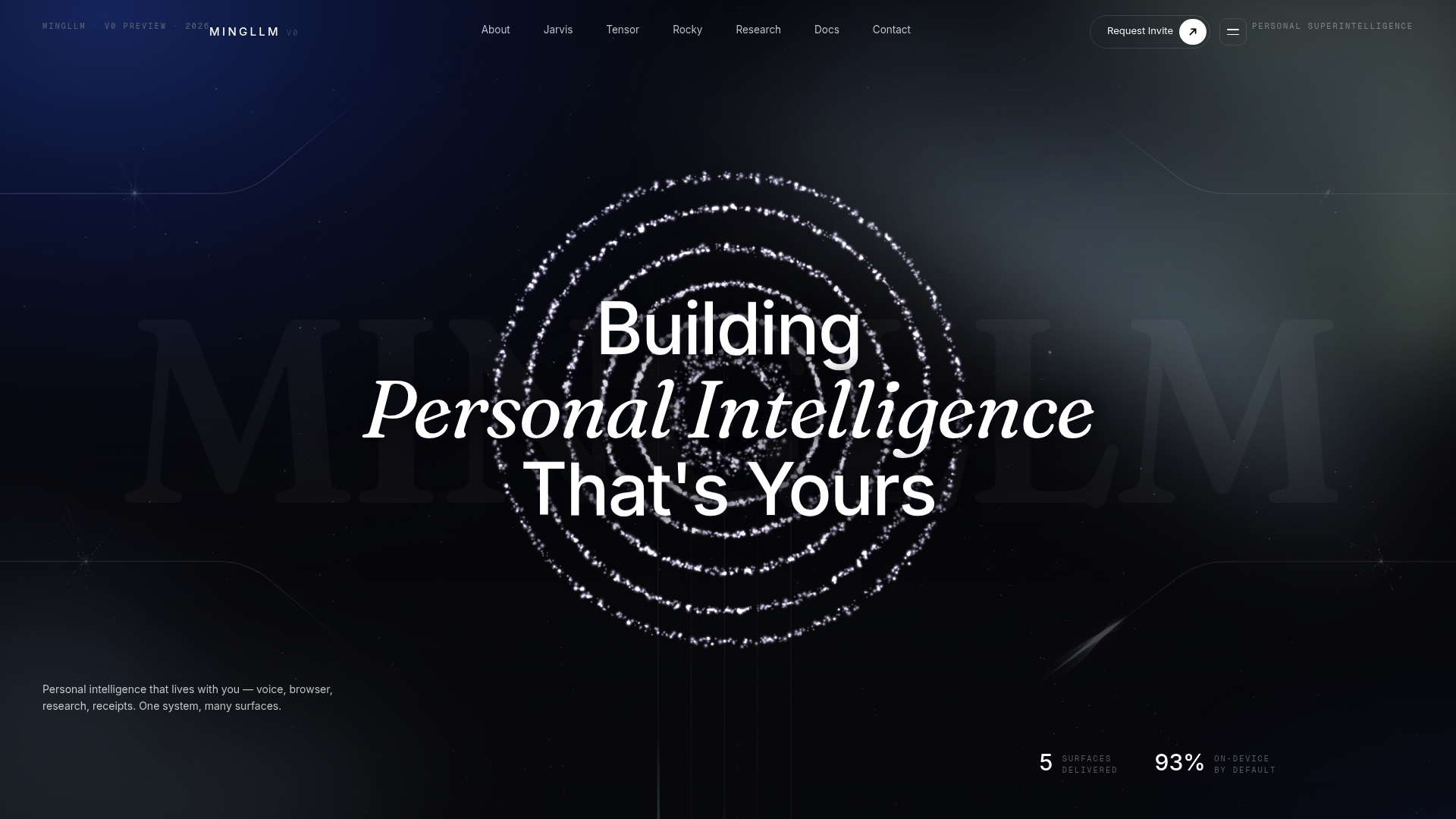
Mingllm runs entirely on your device, which means persistent memory, voice-first control, multi-app integration, and browser-level research synthesis all happen locally. Your board communications, strategic notes, and operational data stay on your hardware. For executives who care about AI governance and control, that’s not a minor detail. It’s the whole architecture. Explore Mingllm’s personal superintelligence platform to see how local-first AI fits into your specific workflow.
FAQ
What are the main types of AI productivity tools for executives?
The five primary categories are workspace AI tools, general AI assistants, meeting intelligence platforms, calendar and task managers, and automation orchestration platforms. Each addresses a different layer of executive workflow friction.
How does AI complement rather than replace a human executive assistant?
AI handles repetitive administrative tasks like inbox triage and meeting prep while human EAs focus on relationship management and complex judgment calls that require real context and discretion.
What should executives look for in an AI productivity tool?
Prioritize persistent memory, deep integration with your existing tools, and configurability. A tool that doesn’t retain context across sessions or connect to your core stack will not produce lasting productivity gains.
How long does it take to see real results from AI executive tools?
Real productivity gains develop over time as executives adjust workflows around AI feedback. Expect meaningful impact after two to four weeks of consistent use and deliberate calibration.
Are AI tools for executives worth the cost?
At $10 to $30 per user per month for most tools, the cost is negligible against recovered executive hours. The more relevant question is whether the tool integrates deeply enough to change behavior, not whether the subscription is affordable.