What Is an AI Acceptable Use Policy in 2026?

Knowing what is an AI acceptable use policy separates organizations that govern AI thoughtfully from those that discover the gap only after a breach or compliance failure. An AI acceptable use policy, formally called an AI AUP, is a governance document that defines permitted and prohibited AI behaviors across your organization. It is not a ban on experimentation. It is the mechanism that makes AI use auditable, defensible, and aligned with your legal and ethical obligations. This article breaks down what belongs in one, how to build it, and how it connects to your broader risk framework.
Table of Contents
- Key takeaways
- What an AI acceptable use policy actually is
- Key components of an effective AI AUP
- Common challenges and best practices
- Integrating AUPs with your AI governance framework
- Practical steps to build and maintain your AI AUP
- My take on what organizations consistently get wrong
- How Mingllm supports responsible AI adoption
- FAQ
Key takeaways
| Point | Details |
|---|---|
| AUPs define boundaries, not bans | An AI AUP specifies permitted and prohibited uses so employees can act with confidence rather than guessing what is allowed. |
| Data classification is non-negotiable | Mapping data categories to approved AI tools prevents sensitive data from entering unapproved systems and triggering regulatory exposure. |
| Text alone is insufficient | Policy enforcement requires operational tooling, identity controls, and audit trails, not just a written document. |
| Human oversight must be enforceable | High-risk AI decisions require documented human verification at intervention points, not a passive sign-off checkbox. |
| AUPs belong inside a governance framework | An AI AUP translates organizational risk appetite into concrete rules, making it a functional layer of your broader AI governance structure. |
What an AI acceptable use policy actually is
The phrase “acceptable use policy” has existed in IT governance for decades, originally applied to internet and email use. An AI AUP extends that tradition to cover generative AI tools, autonomous agents, decision-support systems, and any AI-assisted workflow touching organizational data or processes. An AI AUP defines permitted and prohibited use cases and serves as a governance guardrail against shadow AI, data security incidents, and uncontrolled AI adoption.
What distinguishes an AI AUP from a general AI strategy or ethics statement is specificity. A strategy describes goals. An ethics statement articulates values. An AUP names the tools employees may use, the data they may not input, the decisions that require human review, and the consequences for violations. That specificity is what makes it enforceable.
Shadow AI is the risk that makes an AUP genuinely necessary. Shadow AI refers to AI tools employees adopt without IT or legal awareness, often free consumer-grade models that process company data on external servers with no data retention controls. Shadow AI gaps persist when policies exist only in text without the operational controls to restrict or monitor which tools employees actually use.
An AI AUP does several things simultaneously:
- Establishes a list of approved AI tools and vendors
- Specifies prohibited uses, including inputs of personally identifiable or protected health information into unapproved platforms
- Sets data classification rules that determine what may be entered into which systems
- Defines human oversight requirements for automated decisions
- Creates an incident reporting pathway
- Outlines training requirements and enforcement consequences
These elements together make AI use governable without suppressing productive experimentation. The goal is a clear framework, not a creativity freeze.
Key components of an effective AI AUP
A 2026 enterprise AUP template identifies eight foundational sections: scope, approved tools, data classification, human review, confidentiality, incident reporting, training, and enforcement. Each section carries specific weight.
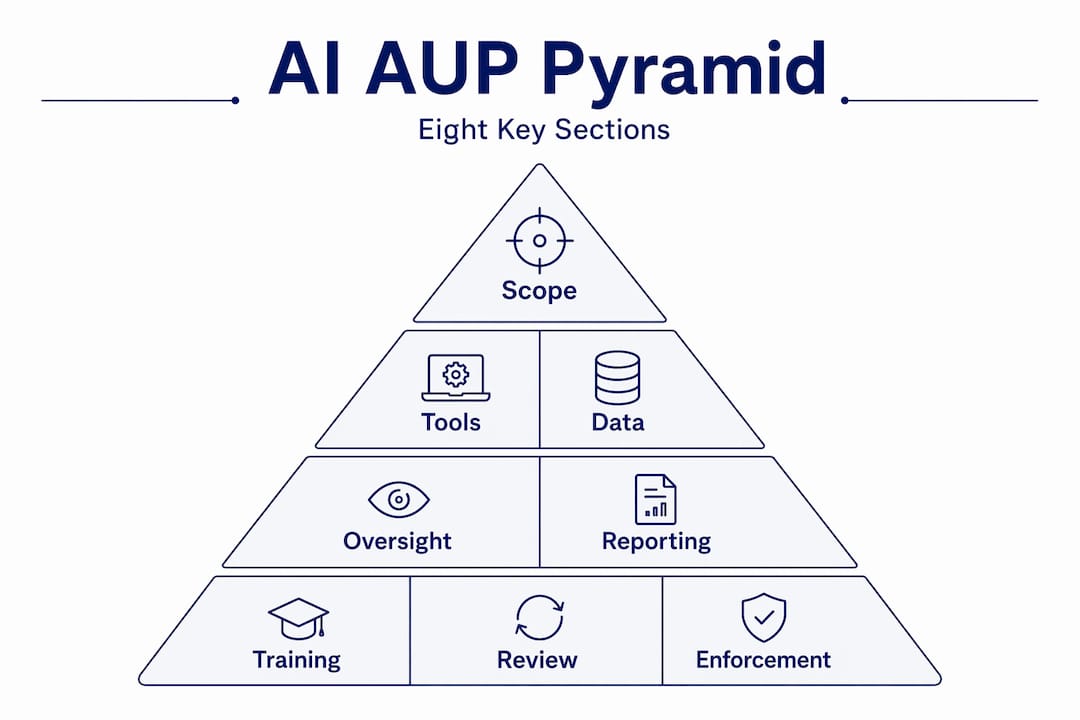
Scope and approved tools
Scope answers who the policy applies to: employees, contractors, vendors, and any third party processing organizational data with AI. Approved tool lists name specific platforms that have passed procurement, security, and legal review. Anything not on the list is implicitly prohibited, which removes the ambiguity that leads to shadow AI.
Data classification rules
This section is where most organizations underinvest. Data classification by level, typically Public, Internal, Confidential, and Restricted, gives employees a practical decision rule. Public data may be entered into approved AI tools freely. Restricted data, such as patient records, financial details, or trade secrets, is either prohibited from AI input entirely or requires explicit written approval from a designated authority.
For example, an HR professional using an AI writing tool to draft job descriptions is working with Internal data at most. The same HR professional asking an AI to analyze performance review notes containing personal identifiers is working with Confidential data and needs a different process entirely.
Pro Tip: Map your data classification tier directly to specific AI tool approval levels in a single reference table. Employees should be able to find the answer to “Can I paste this into the AI?” in under 30 seconds.
Human oversight requirements
Human oversight in agentic AI deployments means more than a passive review. Effective policies mandate intervention points where a qualified person verifies AI outputs before consequential actions occur, with documented audit trails and reversibility where technically feasible. A checkbox labeled “reviewed by manager” does not meet this standard if no one verifies what the review actually covered.

Incident reporting and enforcement
Prompt reporting requirements cover unauthorized access events, data submission errors, and use of unapproved tools. Strong policies include non-punitive provisions for good-faith disclosures to encourage employees to report errors rather than conceal them. Enforcement mechanisms must be proportionate and clearly stated, ranging from mandatory retraining to disciplinary action depending on severity and intent.
Common challenges and best practices
Building the policy document is the easier half. Making it functional is where most organizations stall.
The most common failure mode is the inventory problem. Organizations cannot enforce approved tool lists if they do not know which AI tools employees are already using. Before drafting a policy, conduct a tool inventory across departments, including browser extensions, embedded AI features in existing software, and third-party integrations. This baseline prevents your AUP from being immediately outdated on publication.
Ambiguous language is the second major pitfall. Phrases like “use AI responsibly” or “avoid misuse” carry zero enforcement weight. Every prohibition and permission needs a concrete example. Instead of “do not input sensitive data,” write “do not input data classified as Confidential or Restricted into any AI platform not listed in Appendix A.”
Lack of training is the third gap. Annual AI literacy training covering data handling, prohibited uses, oversight responsibilities, and incident reporting is the minimum standard. Organizations handling regulated data in healthcare, finance, or government contexts should consider quarterly updates as AI capabilities and regulatory interpretations evolve quickly.
Best practices that move policy from paper to practice include:
- Implement identity-based access controls that restrict AI tool access to approved platforms at the network or endpoint level
- Create a lightweight approval workflow for teams requesting new AI tools, with defined turnaround times to reduce shadow adoption pressure
- Maintain a living document with version history, review dates, and named policy owners
- Build AI usage monitoring into existing security information and event management (SIEM) tooling to detect anomalous AI data submissions
Pro Tip: Pair your written policy with a one-page quick reference card that employees can keep at their desks or pin in a shared channel. Policy documents get read once. Quick reference cards get used daily.
Integrating AUPs with your AI governance framework
An AI AUP is not a standalone artifact. It is one functional layer within a broader AI governance framework that spans risk management, procurement, legal, security, and ethics. The NIST AI Risk Management Framework (AI RMF) explicitly recommends using governance artifacts like policies to translate organizational risk appetite into defined acceptance criteria and decision rights.
The relationship between an AUP and other governance components looks like this:
| Governance layer | Role | How the AUP connects |
|---|---|---|
| AI risk management framework | Sets overall risk appetite and thresholds | AUP operationalizes risk appetite into specific rules |
| Security policy | Governs data protection and access controls | AUP specifies AI-specific data handling requirements |
| Procurement policy | Controls vendor selection and contracts | AUP defines the approved tool list and vendor assessment criteria |
| Legal and compliance | Manages regulatory obligations | AUP addresses requirements like GDPR, HIPAA, and sector-specific rules |
| HR and ethics policy | Covers employee conduct | AUP establishes AI-specific behavioral expectations and consequences |
Public-sector GenAI policies increasingly require lifecycle governance documentation aligned with transparency and audit readiness standards. This reflects a broader expectation that AI governance demonstrates accountability to external regulators and auditors, not just internal stakeholders. Understanding AI security risks is a prerequisite for writing an AUP that covers the right threat surface.
Practical steps to build and maintain your AI AUP
A policy that sits in a shared drive unfound and unread is not a policy. Here is a practical sequence for organizations building their first AI AUP or revising an existing one.
-
Form a cross-functional working group. Include IT, legal, HR, compliance, and at least one operational business unit that actively uses AI. Policy written without the people who will live under it tends to miss real-world workflows entirely.
-
Conduct an AI tool inventory. Survey existing AI tool usage across the organization before defining your approved list. You cannot prohibit what you do not know exists.
-
Define your data classification tiers. If your organization does not already have a data classification scheme, now is the time. Map each tier to specific AI use permissions in a reference table.
-
Draft the eight core sections. Use scope, approved tools, data classification, human review requirements, confidentiality obligations, incident reporting, training requirements, and enforcement as your structural framework.
-
Establish human oversight checkpoints. For any AI use case involving decisions about people, finances above defined thresholds, or regulated data, document the specific intervention point, who is responsible, and what the verification process involves.
-
Build a training program. Role-specific training matters more than a single all-hands presentation. A data analyst using AI for modeling has different risk exposure than a customer service representative using AI to draft responses.
-
Set a review cadence. AI capabilities change fast. Schedule a formal policy review every six months, and appoint a named owner responsible for monitoring regulatory changes that may affect your policy.
-
Report AI incidents through an existing channel. Integrate AI incident reporting into your current security incident workflow rather than creating a parallel process. Employees already know how to use it.
My take on what organizations consistently get wrong
I’ve reviewed AI governance frameworks across organizations ranging from small tech teams to large regulated enterprises, and the pattern that keeps appearing is this: the policy gets written with serious care, approved by leadership, and then effectively disappears. The document exists. The enforcement infrastructure does not.
What I’ve found is that the gap between a good AI AUP and a functional one is almost always operational, not conceptual. Organizations understand the principles. They struggle to translate “employees must only use approved AI tools” into a network control that actually blocks unapproved tools, or an identity enforcement rule that restricts access at login. Without that infrastructure, the policy is a statement of intent, not a control.
The second thing I’ve seen consistently underestimated is the clear separation between allowed-with-controls and fully prohibited uses. When policies leave this boundary vague, employees default to one of two bad behaviors: they avoid AI entirely out of fear of violating an unclear rule, or they assume most uses are probably fine and proceed without caution. Neither outcome serves the organization. Explicit lists of prohibited behaviors, paired with an equally explicit list of approved uses, remove that ambiguity entirely.
Translating risk appetite into specific acceptance criteria is where governance gets genuinely difficult, and where most teams need more time than they budget. That work is worth doing slowly and getting right.
— steve
How Mingllm supports responsible AI adoption
If your organization needs AI that respects the data controls your AUP requires, Mingllm is built around exactly that architecture. Mingllm runs entirely locally on the user’s device, which means no organizational data transits external servers and no unapproved third-party platforms handle sensitive inputs.

Mingllm’s detailed action logs and proof traces give policy administrators exactly the audit trail that AI governance frameworks demand: a documented, reviewable record of what the AI did, when, and with what data. For privacy-conscious organizations that need AI capability without sacrificing data control, Mingllm aligns naturally with the human oversight and data handling requirements your AUP will specify. Explore how local AI deployment fits within your acceptable use framework at Mingllm.com.
FAQ
What is an AI acceptable use policy?
An AI AUP is a governance document that defines which AI tools employees may use, what data may be inputted, what decisions require human review, and the consequences for violations. It functions as an enforceable ruleset rather than a general ethics statement.
How does an AI AUP differ from an AI governance framework?
An AI governance framework sets the overall structure, risk appetite, and oversight mechanisms for AI use across an organization. An AI AUP is one operational document within that framework, translating high-level risk tolerance into specific, employee-facing rules.
What data should be prohibited from AI tools?
Data classified as Confidential or Restricted, including personally identifiable information, protected health information, and financial records, should be prohibited from input into unapproved AI platforms. The Arkansas Executive Branch AI policy explicitly prohibits PII and PHI input into unapproved AI tools as a baseline standard.
How often should an AI AUP be reviewed?
A formal review every six months is a reasonable minimum given the pace of AI development and regulatory change. Any significant change to approved tools, organizational risk profile, or applicable regulation should trigger an out-of-cycle review.
What makes an AI AUP actually enforceable?
Enforceability requires operational controls beyond the written document, including approved tool lists backed by access restrictions, identity enforcement, monitoring integrated into existing security tooling, and structured incident reporting. A policy without these controls is an aspiration, not a control.