The Role of AI in Competitive Research in 2026

Most business professionals still think of AI as a faster way to do the same old tasks. Scrape data quicker. Build reports faster. That framing fundamentally undersells what’s actually happening. The role of AI in competitive research has shifted from task assistant to autonomous collaborator, one that can plan entire analysis workflows, surface competitor signals from unstructured sources, and generate decision-grade intelligence in hours instead of weeks. This article breaks down exactly how that works, where the real gains come from, and what governance guardrails you need before you deploy any of it.
Table of Contents
- Key takeaways
- The role of AI in competitive research: from scraper to co-worker
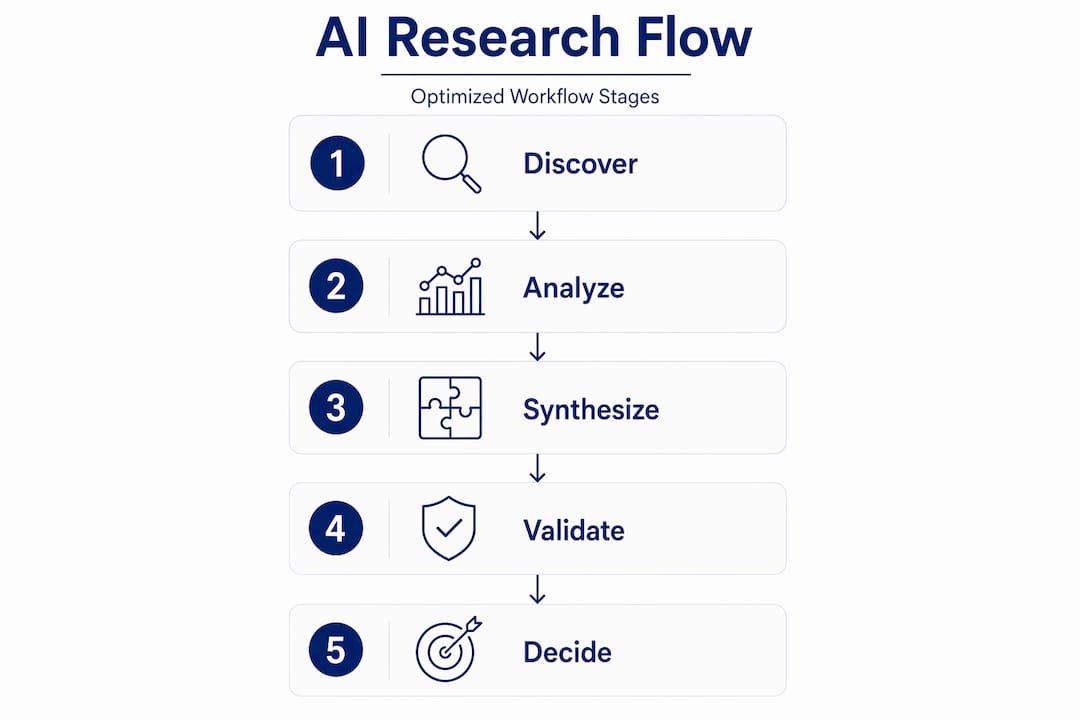
- From raw data to strategic insight: AI across the full research lifecycle
- Redesigning your research workflow for AI
- Governance and risk management for AI-driven intelligence
- My take: AI is a co-worker, not a shortcut
- How Mingllm powers your competitive research locally
- FAQ
Key takeaways
| Point | Details |
|---|---|
| AI accelerates competitor discovery | LLM-based agents achieve 83% recall and cut analyst turnaround from days to hours. |
| Workflow redesign beats task automation | Clustering AI-friendly tasks into sequences reduces handoffs and delivers greater efficiency gains. |
| Human judgment stays irreplaceable | AI handles volume and synthesis; humans own question framing, validation, and strategic interpretation. |
| Governance is non-negotiable | Source traceability and audit trails prevent hallucinations from becoming business decisions. |
| Local AI protects sensitive intelligence | Privacy-focused platforms keep competitive data off third-party servers, reducing exposure risk. |
The role of AI in competitive research: from scraper to co-worker
The standard narrative is that AI helps you collect more data faster. That’s true, but it’s only the first layer. What agentic AI systems do differently is plan, execute, and iterate across a sequence of research steps without waiting for you to hand off each task manually.
Consider what that looks like in practice. A pharmaceutical firm running drug asset due diligence once needed 2.5 days of analyst time to map a competitive landscape. An LLM-based competitor discovery agent completed the same task in roughly three hours with 83% recall, a 20x improvement in turnaround time. That’s not a productivity tweak. That’s a workflow transformation.
The underlying mechanics matter here. These systems don’t just throw raw queries at a language model and hope for useful output. They structure and normalize data first, then use LLM-based validation to vet outputs, which is precisely why recall and precision stay high. Garbage in, garbage out still applies. The difference is that AI can now do the normalization work itself, at scale.
Pro Tip: Before deploying any AI agent for competitor discovery, audit your internal data sources first. An AI system is only as accurate as the structured inputs feeding it. A two-hour data normalization pass upfront will dramatically improve output quality.
For teams that previously could only afford to run one or two major competitive sweeps per year because of cost and timeline, AI-driven research timelines compressing from months to days changes the math entirely. You can now run concept tests after every major competitor announcement, not just quarterly.
From raw data to strategic insight: AI across the full research lifecycle
Data collection is table stakes. The harder problem has always been turning thousands of data points into a coherent competitive picture. This is where generative AI’s role gets genuinely interesting.
Modern AI tools now support the full research lifecycle, including ideation, planning, analysis, and report writing, which means a researcher’s job shifts dramatically. Instead of spending 60% of their time on manual coding, thematic categorization, and narrative drafting, they spend that time framing the right questions and validating what AI surfaces. That’s a much higher-leverage use of expert attention.
What this looks like in practice:
- Unstructured data synthesis: AI reads earnings call transcripts, patent filings, job postings, and press releases simultaneously, then clusters themes by strategic relevance.
- Thematic concept analysis: Rather than reading 200 customer reviews to spot a competitor’s product weakness, AI identifies the pattern and flags the five most representative examples for you to review.
- Narrative generation: AI drafts the competitive summary section of your intelligence report. You edit for strategic framing rather than writing from scratch.
- Autonomous research pipelines: Experimental systems like The AI Scientist can now produce conference-acceptable research papers autonomously, a signal of how close end-to-end competitive intelligence automation actually is.
The nuance worth understanding is that AI-human hybrid approaches consistently outperform either AI-only or human-only research. AI handles the volume and the laborious pattern detection. Humans catch the context errors and make the strategic calls. Neither does the job as well alone.
“Generative AI shifts competitive research effort toward framing questions and validating AI outputs rather than manual coding and data manipulation, unlocking qualitative insights at scale.”
Pro Tip: When using AI for competitive narrative generation, always require the system to cite its source for every claim it makes in the output. If your AI tool can’t link each assertion back to a specific document, treat the output as a draft hypothesis, not a finished insight.
Redesigning your research workflow for AI
Here is where most teams leave the biggest gains on the table. They drop an AI tool into an existing workflow and wonder why the results are underwhelming. The breakthrough comes from redesigning workflows around AI rather than bolting AI onto workflows designed for humans.
The core principle: cluster AI-friendly tasks into continuous sequences. Every time a human has to review output, reformat it, and pass it back to an AI system, you pay a coordination cost. Those handoffs kill efficiency. The goal is to give AI as long a continuous run of tasks as possible before human review is required.
Task-by-task automation vs. workflow-level optimization
| Approach | What you do | Efficiency gain | Strategic impact |
|---|---|---|---|
| Task automation | Replace individual steps with AI | Moderate (per task) | Low, since human handoffs still fragment the workflow |
| Workflow redesign | Cluster AI tasks into sequences | High (compound gains) | High, since AI maintains context across the full chain |
| Continuous monitoring | AI monitors signals and escalates findings | Ongoing | Very high for sustained competitive advantage |
The workflow redesign model also changes what your analysts do day to day. Instead of doing research, they supervise research. They set parameters, validate outputs, and focus on the 10% of findings that require genuine strategic interpretation. That’s not a reduction in the value of human expertise. It’s a concentration of it.
For an AI research agent to do this well, it needs to understand AI agent fundamentals: goal-setting, tool use, memory between steps, and the ability to loop back when a result doesn’t pass a quality check. Not every AI tool on the market does all of this. Before committing to a platform, map your workflow first and then check whether the AI can handle multi-step, stateful tasks or only single-step queries.
Pro Tip: Map your current competitive research process as a flowchart before adding any AI. Circle every step that is primarily data movement, formatting, or pattern detection. Those are your AI candidates. The steps requiring judgment calls stay with your team.
Governance and risk management for AI-driven intelligence
Speed creates a specific kind of risk in competitive intelligence. When you can produce a 40-page competitor analysis in three hours instead of three weeks, the temptation is to skip the validation step. That’s where things go wrong.

AI systems can hallucinate. In casual use, a hallucinated fact is annoying. In a board-level competitive strategy briefing, it’s a serious liability.
The critical controls to put in place:
- Source traceability: Every claim in an AI-generated output should link back to a verifiable source document. Fully traceable AI outputs directly improve the credibility and trustworthiness of competitive intelligence.
- Audit trails: Maintain logs of what data the AI accessed, what prompts it received, and what outputs it generated. This matters for both internal validation and regulatory compliance.
- Human review gates: Build review checkpoints before any AI-generated intelligence reaches a decision-making audience. The goal is not to review everything line by line, but to have a structured process for flagging anomalies.
- Hallucination testing: Periodically test your AI system with queries where you already know the correct answer. If the system fabricates plausible-sounding but wrong information, treat that as a calibration issue to address before production use.
Regulated industries face additional pressure. Financial services firms, for example, must now embed AI risk oversight at the senior management and board level, making it an operational requirement rather than a best practice. Even if your firm isn’t regulated, the discipline applies. Competitive intelligence that can’t be traced back to its sources is just sophisticated guesswork.
The other risk rarely discussed is data exposure. When you run competitive research through cloud-based AI tools, your queries, your competitors’ names, your strategic hypotheses, they all travel to someone else’s servers. For sensitive work, that’s a meaningful security consideration worth building into your platform selection process.
My take: AI is a co-worker, not a shortcut
I’ve watched teams treat AI as a smarter search engine, and I’ve watched teams treat it as a genuine research partner. The results are not comparable.
What I’ve found is that the mindset shift matters as much as the tooling. When you start thinking of AI as a co-worker with specific skills and specific blind spots, you start managing it the way you’d manage a brilliant but overconfident junior analyst. You give it clear tasks, you check its work on anything high-stakes, and you pay attention to the patterns in where it goes wrong.
The most common mistake I see is deploying AI on top of messy, unstructured internal data and then being disappointed when the outputs are vague. AI success in competitive research hinges almost entirely on data quality before the model ever runs. Structured, normalized, well-sourced data going in means specific, trustworthy intelligence coming out.
The balance I’ve landed on is this: let AI handle continuous monitoring, pattern clustering, and first-draft synthesis. Keep humans in charge of question framing, strategic interpretation, and any output that drives a real decision. That division of labor isn’t a compromise. It’s actually where the best intelligence comes from, because AI-human hybrid research reliably outperforms either approach alone.
The teams that will have the sharpest competitive intelligence in the next three years are not the ones with the most AI tools. They are the ones who redesigned their workflows first and then chose tools that fit.
— steve
How Mingllm powers your competitive research locally
If data privacy is part of how you think about competitive intelligence, and for most serious research teams it should be, then the question of where your AI runs matters as much as what it can do.
Mingllm runs entirely on your device. Your research queries, your competitor data, your synthesis prompts: none of it leaves your hardware. The platform’s built-in research tools structure and analyze sources directly, with source citations attached to every output and a full action log so you can trace exactly how any conclusion was reached. For business professionals who need decision-grade intelligence without exposing their strategic thinking to third-party servers, Mingllm’s local AI platform is built for exactly that. Explore what privacy-first competitive research looks like when the model, memory, and reasoning all run on your machine.
FAQ
What is the role of AI in competitive research?
AI functions as an end-to-end research partner that automates data collection, competitor discovery, pattern analysis, and report drafting. Its greatest value comes from redesigning workflows around AI capabilities rather than automating individual tasks in isolation.
How accurate are AI systems at competitor discovery?
LLM-based discovery agents have achieved 83% recall in competitive mapping tasks like drug asset due diligence, cutting analyst turnaround from 2.5 days to roughly three hours. Accuracy depends heavily on data quality and structured inputs feeding the model.
What are the main risks of using AI for competitive intelligence?
The primary risks are hallucinated facts, lack of source traceability, and data exposure through cloud-based AI tools. Establishing audit trails, requiring source citations on every output, and using locally-deployed AI significantly reduces these risks.
Does AI replace human analysts in competitive research?
No. AI-human hybrid approaches consistently produce better intelligence than either method alone. AI handles volume, pattern detection, and synthesis. Humans remain responsible for strategic framing, validation, and decision-making.
How do I start redesigning my workflow for AI-driven competitive research?
Map your current process as a flowchart and identify every step that involves data movement, formatting, or pattern recognition. Those steps are candidates for AI automation. Cluster them into continuous sequences to minimize human-AI handoffs, which is where most efficiency is actually lost.