Private AI vs Enterprise Cloud AI: 2026 Decision Guide

The gap between what enterprise cloud AI promises and what it actually delivers around privacy and control is wider than most organizations realize. As global enterprise AI spending surges to $247 billion in 2026, technology professionals face a decision that goes far beyond picking the fastest or cheapest model: choosing between private AI and enterprise cloud AI shapes your organization’s data sovereignty, regulatory posture, and long-term competitive position. Get it wrong, and you are either hemorrhaging sensitive data through a cloud API or overspending on infrastructure you do not fully utilize. This guide cuts through the noise.
Table of Contents
- Key takeaways
- Private AI vs enterprise cloud AI: the core distinction
- What enterprise cloud AI actually offers
- Comparing security, privacy, compliance, and costs
- Hybrid AI deployment strategies
- Key factors for evaluating your AI deployment choice
- My take on this decision
- How Mingllm supports your private AI strategy
- FAQ
Key takeaways
| Point | Details |
|---|---|
| Cloud AI has real privacy limits | Cloud providers retain operational visibility into your prompts and documents, which creates unavoidable exposure. |
| Private AI pays off at scale | High-volume, predictable workloads become more cost-effective on private infrastructure by eliminating per-token charges. |
| Compliance demands isolated infrastructure | Regulated industries need air-gapped or regionally isolated deployments to satisfy GDPR and sector-specific data residency laws. |
| Hybrid models are the pragmatic path | Routing sensitive tasks to private AI and general workloads to the cloud gives you performance and protection simultaneously. |
| Organizational readiness matters as much as tech | Governance, workflow integration, and AI maturity determine whether either deployment model actually delivers results. |
Private AI vs enterprise cloud AI: the core distinction
Before comparing the two models head-to-head, it helps to clarify terminology. “Private AI” is shorthand for what practitioners more formally call on-premises or private-cloud AI deployment, meaning the models, inference engines, and associated data pipelines run entirely within infrastructure you control. This includes physical servers in your own data center, virtual private clouds with strict network isolation, and air-gapped environments where no external party has access to compute or data at rest.
The private AI model operates under a foundational principle: providers cannot access your inputs or outputs. This is not a contractual guarantee; it is an architectural one. When a model runs on your hardware, there is no API call leaving your perimeter, no vendor logging your prompts, and no third-party data retention policy to audit.
Core private AI benefits worth knowing
The advantages of this model go beyond the obvious privacy argument:
- Data sovereignty. Your organization sets the retention policy. Zero-retention configurations are fully enforceable because you control the storage layer.
- Model customization. Fine-tuning on proprietary datasets stays inside your environment. The resulting model weights never travel to a vendor’s servers.
- Audit trails you own. Governance frameworks get real teeth when you control the logging infrastructure entirely.
- Compliance by architecture. Solutions like regionally isolated, compliant model deployment with ISO 27001 and SOC 2 Type II certifications show that private AI can meet enterprise compliance requirements without relying on vendor promises.
Pro Tip: If your legal or compliance team cannot get a definitive answer from a cloud AI vendor about where your prompt data is logged and for how long, treat that as a red flag, not a minor detail.
What enterprise cloud AI actually offers
Enterprise cloud AI refers to AI capabilities delivered through public or shared infrastructure from providers who manage the underlying compute, models, and scaling. Think of the managed AI API services offered by major cloud providers, where you send a request and receive a response without touching the server infrastructure yourself.

The appeal is real and quantifiable. AI budgets average 14.6% of total IT spend in 2026, and cloud AI lets organizations start generating value without a large upfront hardware commitment. You pay for what you use, and you get access to frontier model capabilities the moment a provider releases them.
The limitations are equally real:
- Provider data visibility. Cloud AI providers have operational visibility into the prompts, documents, and outputs processed through their APIs. Contract language can restrict how that data is used, but it cannot make the provider technically blind to it.
- Limited fine-tuning control. You can customize behavior through prompting and retrieval-augmented generation, but you rarely control the base model weights or training pipeline.
- Data residency complexity. Multi-tenant cloud infrastructure makes true data residency guarantees difficult. Contractual commitments are not the same as architectural guarantees.
- Vendor lock-in risk. Migrating workloads away from a cloud AI platform after deep integration is expensive and time-consuming.
Typical use cases where cloud AI excels include customer-facing chatbots, general document summarization, code assistance for non-sensitive repositories, and exploratory analytics where the data carries no regulatory weight.
Comparing security, privacy, compliance, and costs
This is where the decision gets concrete. The table below maps the two models across the dimensions that matter most to technology decision-makers.
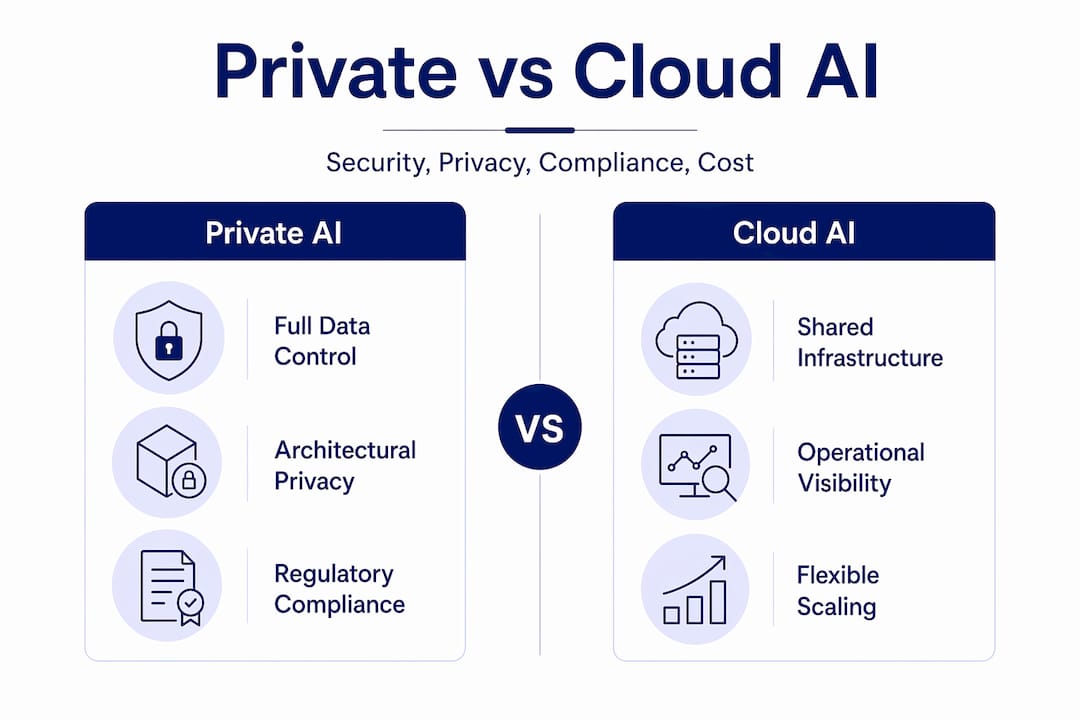
| Dimension | Private AI | Enterprise cloud AI |
|---|---|---|
| Data control | Full. No external access by architecture. | Partial. Governed by vendor contracts and policies. |
| Privacy guarantee | Architectural. Provider cannot access data. | Contractual. Provider has technical access. |
| Security model | Isolated. You manage the perimeter entirely. | Shared responsibility with the vendor. |
| Regulatory compliance | Stronger for GDPR, HIPAA, and sector laws. | Sufficient for low-sensitivity workloads. |
| Upfront cost | High. Hardware, licensing, and setup required. | Low. Consumption-based pricing, zero upfront. |
| Cost at scale | More efficient. No per-token charges at volume. | Expensive. Per-token costs grow with usage. |
| Customization depth | Deep. Full model ownership and fine-tuning. | Shallow. Prompt engineering and retrieval only. |
| Auditability | Complete. You own every log and trace. | Limited. Vendor controls the audit layer. |
Regulated industries consistently find that cloud agreements alone are insufficient for protecting sensitive IP, attorney-client privilege, or patient data. The architectural reality is that air-gapped infrastructure is the only way to guarantee that a provider cannot access data being processed.
On the cost side, the calculus shifts predictably with volume. Private AI infrastructure becomes more cost-effective at high usage volumes by eliminating per-token costs. If you are running tens of millions of inference requests per month on predictable workloads, the hardware investment pays for itself. For unpredictable or low-volume workloads, cloud AI remains the better economic choice.
Pro Tip: Model your AI workloads for the next 18 months before committing to either deployment approach. If you expect usage to scale significantly, run a break-even analysis against private infrastructure costs. Most organizations hit the crossover point sooner than they expect.
Hybrid AI deployment strategies
Neither model is universally superior. The organizations getting the most out of AI in 2026 are using both. Hybrid AI deployments route sensitive tasks to private AI and general-purpose or scale-intensive workloads to public cloud AI, using AI gateway technologies to manage that routing automatically.
A hybrid architecture typically works like this:
- Classify data sensitivity at ingestion. Requests containing PII, financial records, or privileged information route to private inference endpoints.
- Route general workloads to the cloud. Tasks like summarizing public web content or generating marketing copy go to the cloud, where cost and latency advantages hold.
- Use an AI gateway as the control plane. The gateway enforces routing rules, logs decisions, and provides a single point of governance across both environments.
- Maintain model consistency. Where possible, use compatible model families in both environments so that output quality stays predictable regardless of routing.
The challenges are real, too. Hybrid architectures add operational complexity, require clear data classification policies, and demand mature security practices at the gateway layer. Organizations with limited DevOps capacity often underestimate what it takes to keep both environments synchronized.
Pro Tip: Start your hybrid deployment with a small number of well-defined sensitive use cases routed to private infrastructure. Get that pipeline clean and auditable before expanding. Boiling the ocean on day one is how hybrid projects stall.
Key factors for evaluating your AI deployment choice
If you are currently comparing private and cloud AI options for your organization, the decision depends on more than a feature matrix. These are the dimensions that actually determine whether your choice succeeds:
-
AI maturity and organizational readiness. Only about a third of companies have begun scaling AI beyond pilot programs. If your organization is still in the experimentation phase, the operational overhead of private AI may slow you down more than it protects you.
-
Data sensitivity and regulatory exposure. Map your workloads to their data sensitivity levels before choosing an architecture. If any workload touches regulated data categories, compliance with GDPR, HIPAA, or financial sector rules may legally require isolated infrastructure regardless of cost.
-
Cost structure and usage patterns. Consumption-based cloud pricing looks cheap at low volume. Run your projected usage numbers through a realistic cost model that includes 18 to 36 months of growth. The per-token cost disadvantage of cloud AI compounds fast for high-throughput applications.
-
Vendor SLAs and data residency requirements. Understand exactly what your cloud AI vendor’s SLA covers and does not cover. Data residency commitments buried in an addendum are not the same as architectural isolation.
-
Governance, auditability, and risk management. The AI maturity gap is a documented constraint. Many organizations limit AI use to low-stakes applications because they lack the governance frameworks to deploy it confidently on critical workloads. Building those frameworks is a prerequisite, not an afterthought.
-
Workforce readiness for cloud security practices. Reviewing cloud security best practices as part of your evaluation prevents you from discovering gaps after deployment rather than before.
My take on this decision
I have watched organizations agonize over the private versus cloud AI question for years, and the pattern I keep seeing is this: teams underestimate the compliance complexity of cloud AI and overestimate the operational simplicity of private AI. Both assumptions lead to pain.
The compliance gap in cloud AI is not theoretical. Standard enterprise agreements give you contractual language, not technical guarantees. When a regulator asks for evidence that your AI system never transmitted patient data to a third party, a contract clause is a weak answer. An architecture diagram showing an air-gapped inference environment is a strong one.
On the private AI side, the AI maturity gap is the real obstacle. Running models on-premises sounds straightforward until you factor in model versioning, hardware provisioning, security patching, and the workflow integration work required to make inference results actually useful. Teams that skip those foundations end up with expensive infrastructure that underperforms a basic cloud API.
What I find genuinely interesting about the current market is the funding mismatch. Private models are projected to generate 70% of AI revenue within five years, yet the capital is still chasing public foundation models. That gap will close, and the organizations that build private AI competency now will have a meaningful head start when it does.
My actual advice to technology leaders: stop treating this as a binary choice in your planning documents. The question is not “private or cloud?” It is “which workloads belong where, and do we have the governance infrastructure to manage both safely?”
— steve
How Mingllm supports your private AI strategy
If the case for running AI locally resonates with you, Mingllm is worth a close look. Built on a local-first architecture, Mingllm runs models, memory, and reasoning entirely on your device. No prompts leave your machine. No vendor has operational visibility into your work. The platform supports voice interaction, browser-integrated research, and native macOS app control, all processed on your hardware.
For technology professionals who need private AI benefits without the complexity of standing up dedicated server infrastructure, Mingllm offers a practical entry point. The platform includes detailed action logs and proof traces so you can audit exactly what the AI did and why. That kind of transparency is rare in any deployment model, private or cloud. Explore what local-first AI looks like in practice at mingllm.com.
FAQ
What is the main difference between private AI and cloud AI?
Private AI runs on infrastructure you control, meaning no external provider can access your data by design. Enterprise cloud AI delivers model capabilities through shared infrastructure, offering easier access but giving the provider technical visibility into your prompts and outputs.
When does private AI become more cost-effective than cloud AI?
Private AI infrastructure becomes more cost-effective at high usage volumes because you eliminate per-token charges. For predictable, high-throughput workloads, the hardware investment typically pays off faster than most organizations expect.
Is enterprise cloud AI compliant with GDPR and HIPAA?
Cloud AI contracts can include GDPR and HIPAA addenda, but contractual commitments are not the same as architectural guarantees. Regulated industries often require isolated or air-gapped deployments to satisfy data residency requirements in a way that holds up to regulatory scrutiny.
What is a hybrid AI deployment strategy?
A hybrid strategy routes sensitive workloads to private AI infrastructure while using public cloud AI for general-purpose or low-sensitivity tasks. An AI gateway typically manages routing decisions automatically based on data classification rules.
How do I know if my organization is ready for private AI?
Assess your AI maturity honestly. Only about a third of enterprises have moved beyond AI pilots, and private infrastructure adds operational overhead that requires mature DevOps, governance, and security practices to manage effectively.