AI cognitive architecture: boost local intelligence and privacy

Most macOS power users think AI is just a black box. You send in a prompt, a pattern-matching engine runs somewhere in a data center, and a response comes back. That framing is dangerously incomplete. AI cognitive architecture is a blueprint that defines how an intelligent system perceives, remembers, reasons, learns, and acts, simulating human-like cognition through integrated modules. Understanding this blueprint is what separates a passive AI consumer from someone who can design, evaluate, and control local AI systems on their own hardware, with their own data staying exactly where it belongs.
Table of Contents
- Understanding AI cognitive architecture: The blueprint for intelligence
- Classic vs. modern cognitive architectures: Key frameworks and approaches
- Key methodologies: Memory types, reasoning strategies, and hybrid approaches
- Metacognition, limitations, and edge cases: Why architectures matter for real-world use
- Practical applications: On-device AI cognitive architecture for privacy on macOS
- A fresh perspective: Why local cognitive architecture is the true unlock for privacy-conscious users
- Take the next step: Bringing superintelligent privacy to your macOS device
- Frequently asked questions
Key Takeaways
| Point | Details |
|---|---|
| Blueprint for smart AI | Cognitive architecture integrates memory, reasoning, and learning to simulate human intelligence in AI systems. |
| Local privacy wins | Modern architectures allow full AI operation on macOS, enabling privacy-first features with no cloud dependency. |
| Metacognition boosts performance | Agent metacognition is crucial for tackling complex, ill-structured tasks and outperforming traditional LLMs. |
| Hybrid methodologies matter | Combining symbolic reasoning with LLMs creates more reliable cognitive frameworks for both accuracy and adaptability. |
| Practical application | You can enhance privacy and intelligence by running cognitive architectures locally on your macOS device. |
Understanding AI cognitive architecture: The blueprint for intelligence
Building on our core definition, let’s break down what makes up cognitive architecture and why it’s essential for AI intelligence.
Think of cognitive architecture not as a single algorithm but as a city’s infrastructure. Different districts handle different jobs: a sensory district processes incoming data, a memory district stores what matters, a reasoning district makes decisions, and an action district executes those decisions. Remove any one district and the city stops functioning coherently.
AI cognitive architecture simulates human-like cognition through tightly integrated modules for memory, decision-making, learning, and action. This integration is what makes architectures fundamentally different from standalone deep learning models, which typically optimize a single function like image recognition or text generation without any awareness of broader context or history.
The core modules every serious cognitive architecture includes:
- Perception: Converts raw inputs (text, audio, sensor data) into structured internal representations
- Working memory: Holds active context during a task, analogous to what you keep “in mind” while solving a problem
- Long-term memory: Stores persistent knowledge across sessions (semantic, episodic, and procedural types)
- Reasoning engine: Applies logic, heuristics, or learned patterns to make decisions
- Learning module: Updates knowledge and strategies based on experience and feedback
- Action interface: Executes outputs, whether generating text, calling APIs, or controlling native apps
“The difference between a cognitive architecture and a standalone model is the difference between a brain and a neuron. One operates; the other merely fires.”
This is why open source AI models running locally become genuinely powerful only when wrapped in an architectural layer that gives them memory, context, and goal-directed behavior. A raw model is a tool. An architecture is the craftsman who knows when and how to use it. For macOS users interested in true device intelligence, the architectural layer is what transforms a downloaded model into something that actually understands your workflow.
Exploring AI research tools built on strong cognitive frameworks illustrates this vividly. Tools that persist research context across sessions, cite sources, and reason about contradictions are architecture-driven. Tools that just autocomplete text are not.
Classic vs. modern cognitive architectures: Key frameworks and approaches
With the basics established, we can now compare how different cognitive architectures evolved, from classic to modern agentic designs.
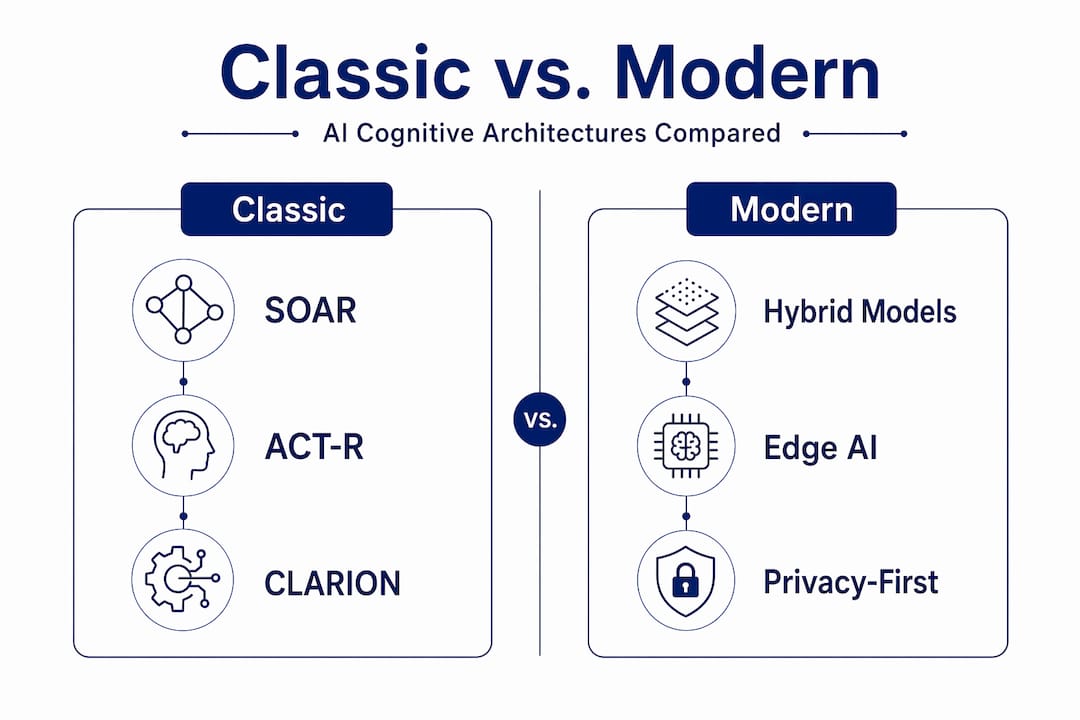
Classic examples include SOAR, ACT-R, and CLARION, each built on decades of cognitive science research. SOAR (State, Operator, and Result) uses production rules and universal subgoaling to solve problems. ACT-R (Adaptive Control of Thought-Rational) models human cognition down to the millisecond, with separate memory buffers that mimic neural subsystems. CLARION separates explicit (conscious) from implicit (procedural) knowledge processing.
| Architecture | Memory model | Reasoning type | Strengths | Weaknesses |
|---|---|---|---|---|
| SOAR | Working + procedural | Rule-based production | Explicit, debuggable | Brittle on novel tasks |
| ACT-R | Declarative + procedural | Activation spreading | Human-accurate modeling | Slow, narrow scope |
| CLARION | Explicit + implicit dual | Bottom-up + top-down | Handles implicit learning | Complex to implement |
| ReAct (LLM-based) | Prompt + vector store | Iterative thought-act | Flexible, general | Unreliable on ill-structured tasks |
| Neurosymbolic hybrid | Typed semantic memory | LLM + symbolic rules | Accuracy + generality | Integration overhead |
Modern architectures use loops like ReAct with working memory and long-term memory modules, often layering large language models with symbolic reasoning for reliability. ReAct alternates between generating reasoning traces and taking actions, grounding abstract language model outputs in concrete tool calls and observable results.
The progression toward modern agentic design happened in four recognizable steps:
- Classic rule systems (1970s-1990s): Explicit symbolic rules, hand-coded knowledge bases, highly interpretable but inflexible
- Connectionist models (1990s-2000s): Neural networks learning statistical patterns, flexible but opaque
- Hybrid early agents (2010s): Combining neural perception with symbolic planning, first attempts at general-purpose cognition
- LLM-era agentic frameworks (2020s-present): Foundation models as reasoning engines wrapped in architectural loops with retrieval, memory, and tool use
Pro Tip: When evaluating any AI agent for local use on macOS, ask specifically what memory architecture it uses. A tool that only has in-context memory forgets everything between sessions. One with persistent episodic and semantic memory can genuinely learn your patterns over time.
Local AI model execution is where these architectural choices get real. Running a capable architecture locally means you get the reasoning benefits of modern design without sending a single byte of your data to a remote server.

Key methodologies: Memory types, reasoning strategies, and hybrid approaches
Now that we’ve seen how frameworks have evolved, let’s unpack the methodologies that power robust and reliable AI cognition.
Memory is not monolithic. Key methodologies include modular decomposition, hybrid neurosymbolic approaches, and global workspace-inspired attention, each serving a distinct function in the overall architecture.
The three memory types that matter most:
- Semantic memory: Stores factual knowledge, concepts, and relationships. Think of it as the agent’s encyclopedia, stable across time.
- Episodic memory: Stores specific past experiences with temporal context. This is what lets an agent remember that last Tuesday you asked it to summarize a specific paper.
- Procedural memory: Stores how-to knowledge, the skills and routines an agent executes without consciously “thinking” about them.
The empirical gains from getting memory right are not subtle. Typed knowledge separation improves accuracy by 12.8% on the BEAM benchmark, a structured evaluation suite for cognitive agent performance. That is not a marginal gain. It is the difference between an agent that reliably completes multi-step research tasks and one that loses the thread halfway through.
| Memory type | Storage scope | Example use case | Local implementation |
|---|---|---|---|
| Semantic | Persistent, global | Domain knowledge, facts | Vector store, knowledge graph |
| Episodic | Persistent, temporal | Session history, past tasks | Timestamped event log |
| Procedural | Persistent, behavioral | Macro execution, app control | Script library, skill index |
| Working | Ephemeral, in-context | Current task reasoning | LLM context window |
Hybrid neurosymbolic approaches are the current frontier. They combine the broad language understanding of large language models with the precision and verifiability of symbolic logic. An LLM handles ambiguous natural language input. A symbolic layer applies deterministic rules to ensure consistent outputs. Together, they reduce hallucination while preserving generality.
Global workspace theory, originally a model of human consciousness, inspired an attention mechanism where relevant information is “broadcast” across all modules. Rather than siloing perception and reasoning, a global workspace architecture lets the reasoning module query memory and perception simultaneously, enabling richer, more coherent responses.
“An agent without proper memory typing is like a developer without version control: technically functional, but accumulating invisible debt with every session.”
Good architectural thinking also feeds directly into AI data protection. When memory is modular and typed, you can encrypt specific layers independently, apply access controls per memory type, and audit what the agent actually knows. Monolithic memory makes that kind of granular protection nearly impossible.
For users wanting an additional hardware layer, techniques like spatial encryption for privacy represent physical-layer protections that pair well with software-level memory isolation.
Metacognition, limitations, and edge cases: Why architectures matter for real-world use
As methodologies get more sophisticated, let’s explore where architectures struggle and why metacognition matters in agent performance.
Metacognition means an agent’s ability to think about its own thinking. Can it recognize when it doesn’t know something? Can it identify when its reasoning strategy is failing and switch approaches? For complex real-world tasks, this capability is not optional.
LLMs fail on ill-structured problems requiring metacognition, diverse representations, temporal reasoning, and contradiction resolution. Classical architectures handle these challenges via explicit mechanisms, but they lack the generality that makes LLMs useful across domains. This is the central tension in current AI architecture research.
The failure modes are specific and consequential:
- Temporal reasoning failures: Agents confuse the order of events, treating past states as current or vice versa
- Contradiction blindness: When two retrieved facts conflict, LLMs often average them rather than flagging the contradiction for resolution
- Metacognitive silence: Agents rarely signal uncertainty even when their confidence should be low, defaulting instead to confident-sounding incorrect answers
- Ill-structured problem collapse: When a task lacks clear success criteria, LLMs frequently generate locally coherent but globally incoherent plans
What makes this especially concerning is a performance regression trend. Frontier models regress in strategy simulation benchmarks relative to mid-2025 baselines, scoring below the average human MBA. Raw model scale alone is not solving the metacognition gap.
Classic architectures handle these cases better because they make reasoning explicit. SOAR’s universal subgoaling can detect impasse states and restructure problem-solving on the fly. ACT-R’s activation-spreading memory distinguishes between high-confidence and low-confidence retrievals. But neither architecture generalizes to the breadth of tasks a modern LLM handles effortlessly.
Pro Tip: When testing any local AI agent on macOS, deliberately give it a task with contradictory information in the source material. Agents with strong metacognitive architecture will flag the contradiction. Agents without it will silently pick one interpretation and proceed, which is far more dangerous for knowledge work.
The good news for privacy-focused macOS users: offline AI assistant designs increasingly incorporate explicit metacognitive hooks, letting the agent log uncertainty, request clarification, or escalate to a different reasoning strategy rather than hallucinating confidently.
Practical applications: On-device AI cognitive architecture for privacy on macOS
Finally, let’s see how these architectures directly impact your macOS experience, empowering privacy and smarter computation on your device.
On-device cognitive architecture is not a theoretical future state. It is deployable today on Apple Silicon, and the architectural choices you make at setup determine both capability and privacy posture.
Architectures enable on-device inference with tools like Ollama and llama.cpp, local retrieval-augmented generation (RAG), encrypted storage, and fully air-gapped operation. SuperLocalMemory, as one architectural reference, uses six distinct retrieval channels and performs all behavioral learning locally, meaning your usage patterns never leave your device.
Local cognitive architectures like Exocortex use a triadic sensing-reasoning-acting loop on edge hardware, ensuring data sovereignty through containerization and zero telemetry. The triadic loop means the agent continuously senses the environment (your macOS state, open apps, files), reasons about what actions are relevant, and acts in reversible, auditable ways.
Key privacy-first features that a well-designed on-device cognitive architecture should include:
- Encrypted vector stores: Semantic and episodic memory stored in encrypted databases that only your device can read
- No-cloud inference: All model execution happens on-device using Apple Silicon’s Neural Engine and CPU
- Containerized memory isolation: Different memory types are stored in separate containers with independent access controls
- Zero telemetry by default: No usage data, no behavioral logging sent externally
- Reversible actions: Every agent action generates an audit log, and macOS-level actions can be undone
- Local RAG pipelines: Document retrieval and synthesis happen entirely on-device, never uploading your files to a third-party server
Pro Tip: Before adopting any local AI architecture on your Mac, check whether it writes any data to a shared or cloud-accessible location by default. Use macOS’s built-in network monitor or Little Snitch to verify that inference and memory operations generate zero outbound traffic.
The architectural advantage of local AI for privacy goes deeper than just “no cloud.” When your cognitive architecture runs locally, you control the entire stack: model weights, memory schema, retrieval logic, and action permissions. That is genuine data sovereignty, not a privacy policy promise.
A fresh perspective: Why local cognitive architecture is the true unlock for privacy-conscious users
Here is where conventional wisdom in AI architecture research gets it wrong, and where the practical implications for macOS users are largest.
The research literature overfocuses on decomposition (60% of studies) versus metacognition (just 16%), yet metacognition is what actually drives success on complex, ambiguous problems. The field is optimizing the wrong variable. Building more modules does not make an agent smarter if those modules cannot reflect on their own outputs and course-correct.
For privacy-conscious power users, this has a direct implication: an architecture that logs its own reasoning, flags uncertainty, and exposes its decision trail is not just more reliable. It is also more auditable. You can see exactly why the agent did what it did, which is the foundation of trust in any local AI system. Opacity is a privacy risk, not just a usability problem.
The missing piece that most architectures have not solved yet is a proper knowledge layer. This means bi-temporal memory that distinguishes between when a fact was true and when the agent learned it, and supersession logic that correctly updates beliefs when new information contradicts old. Without this layer, agents accumulate stale knowledge that degrades performance silently over time.
Open source models built for privacy are increasingly incorporating these features, but the triadic sensing-reasoning-acting loop running locally on your Mac is the architecture most likely to deliver genuine persistence, reliability, and privacy together. The next leap in personal AI will not come from bigger models running in data centers. It will come from smarter architectures running on your hardware.
Take the next step: Bringing superintelligent privacy to your macOS device
Understanding cognitive architecture changes how you evaluate every AI tool you use. It shifts the question from “what can this model do?” to “how does this system think, remember, and protect my data?”
MingLLM is built on exactly these principles, running models, memory, and reasoning entirely on your macOS device with no cloud dependency and full transparency through action logs and proof traces. Every component of the cognitive architecture, from voice-driven task execution to browser-based synthesis to multi-step research, runs locally. If you want to see what privacy-focused local AI looks like when it is architecturally sound, start there. Your data stays on your hardware, your reasoning is auditable, and your intelligence is genuinely yours.
Frequently asked questions
How does AI cognitive architecture differ from deep learning?
Cognitive architecture integrates memory, reasoning, learning, and action into a unified system, while deep learning typically optimizes a single function like pattern recognition without broader contextual awareness or persistent memory.
Can I run AI cognitive architectures locally on my Mac?
Yes. Modern frameworks support on-device inference via Ollama and llama.cpp, local RAG, encrypted storage, and fully offline operation, giving you complete control over data and computation.
Why is metacognition important in AI agents?
Metacognition lets agents recognize when they are wrong, switch reasoning strategies, and flag uncertainty. Without it, LLMs struggle with ill-structured problems and produce confident but incorrect outputs on complex tasks.
What privacy advantages do edge AI architectures offer?
Local architectures ensure data sovereignty through containerized memory isolation, zero telemetry, and fully on-device computation, meaning your behavioral data and knowledge never leave your hardware.
How can I enhance AI data protection on macOS?
Choose architectures that support encrypted storage and no-cloud operation, then verify the claim using macOS network monitoring tools to confirm zero outbound data during inference and memory operations.