AI Model Size Tradeoff: A Data Scientist’s 2026 Guide

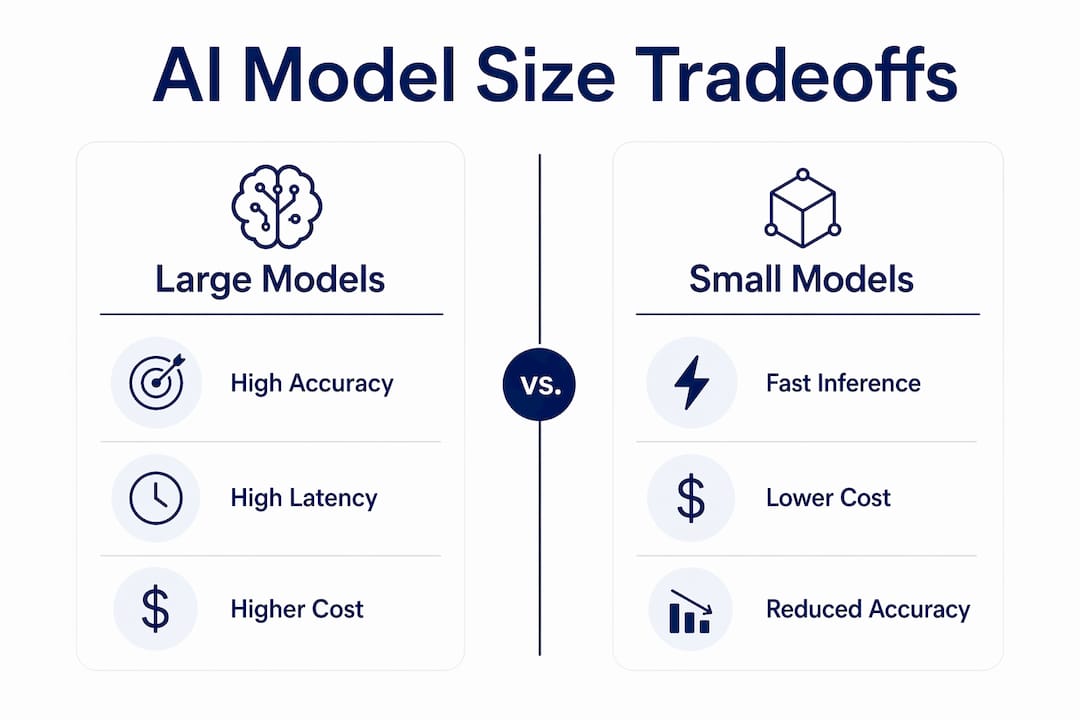
The AI model size tradeoff is the balance between model complexity and the computational resources, latency, and cost required to run it. Larger models like Meta’s Llama 3.3-70B or OpenAI’s GPT-4 class systems capture richer patterns and produce higher-quality outputs, but they demand more GPU memory, longer inference times, and significantly higher operating costs. Smaller models respond faster and cost less to serve, yet they may miss nuance on complex tasks. Understanding this tradeoff is not optional for data scientists and ML engineers. It determines whether your deployment is viable, affordable, and fast enough to matter.
What is the AI model size tradeoff in practice?
The AI model size tradeoff is formally described as the inference trilemma: the three-way tension between throughput, latency, and cost that makes it impossible to optimize all three simultaneously. Push throughput higher by batching more requests, and latency climbs. Cut latency by reserving dedicated GPU capacity, and cost spikes. Every deployment decision forces a compromise somewhere in that triangle.
The numbers make this concrete. Moving from a mid-size model to a larger one can produce a 2.4× slower runtime and roughly 10× cost increase for only a 40% gain in output quality. That is not a linear return on investment. For most production workloads, that math does not close.
- Quality: Larger models generalize better across diverse prompts and handle multi-step reasoning more reliably.
- Latency: Decode speed is memory bandwidth bound, not compute bound. A 70B model moves more weights per token than a 7B model, so each generated token takes longer regardless of GPU count.
- Cost: GPU-hours scale with model size, but KV cache memory requirements scale with both model size and context length, creating a compounding cost effect.
- Hardware constraints: Consumer-grade hardware like Apple M-series chips or single NVIDIA RTX 4090 cards caps out quickly with models above 13B parameters at full precision.
“End-to-end experience depends heavily on serving behavior — output length, concurrency — beyond mere parameter count, complicating the ‘bigger is better’ assumption.” — AWS Developer Blog
Pro Tip: Before selecting a model size, profile your actual workload: average output token length, peak concurrent users, and acceptable p95 latency. These three numbers constrain your viable model size range more than benchmark scores do.
How does GPU memory and KV cache shape model size decisions?
Parameter count is only part of the memory equation. The KV (key-value) cache, which stores attention states for every token in a context window, often consumes more GPU memory than the model weights themselves. This is the detail most sizing guides omit.
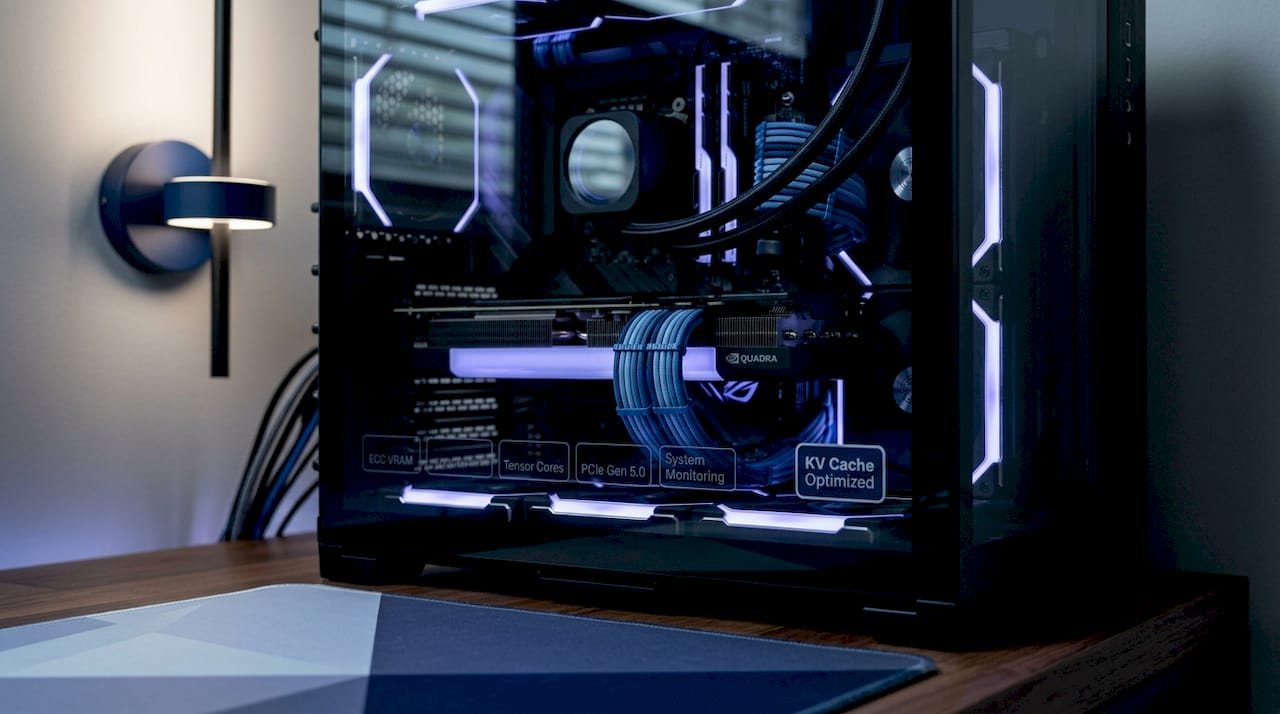
A 70B parameter model stored in FP16 occupies roughly 140 GB of GPU memory. But add a 128K context window with just four concurrent requests, and the KV cache alone can require ~160 GB. That exceeds the model weights entirely. The practical implication: your hardware selection must account for peak KV cache load, not just model weight storage.
| Scenario | Model weights (FP16) | KV cache (128K ctx, 4 req) | Total GPU memory needed |
|---|---|---|---|
| Llama 3.3-70B, FP16 | ~140 GB | ~160 GB | ~300 GB |
| Llama 3.3-70B, FP8 | ~70 GB | ~80 GB | ~150 GB |
| 7B model, FP16 | ~14 GB | ~16 GB | ~30 GB |
| 7B model, INT4 | ~4 GB | ~8 GB | ~12 GB |
Quantization is the most direct lever for managing this pressure. FP8 quantization on Llama 3.3-70B retains over 99% quality while cutting latency by 30% and increasing throughput by 50%. That is a rare case where a single technique moves all three trilemma dimensions in the right direction. Hybrid strategies that apply FP8 for attention layers and INT4 for MLP blocks compress large models onto fewer GPUs while protecting the most quality-sensitive components.
One more factor that rarely appears in sizing guides: naïve KV cache allocation wastes 60 to 80% of reserved memory due to fragmentation. Paged attention reduces that waste to under 4%, which directly multiplies the number of concurrent requests your hardware can serve. For teams running self-hosted LLMs, this single optimization can double effective concurrency without adding a single GPU.
Pro Tip: When planning GPU memory for a deployment, calculate KV cache size as: 2 × num_layers × num_kv_heads × head_dim × context_length × batch_size × bytes_per_element. Then add model weights on top. Never size hardware based on model weights alone.
How do parallelism strategies affect model size tradeoffs?
Once a model exceeds single-GPU memory capacity, you need parallelism. The three primary strategies each carry different tradeoffs that feed directly back into the model size decision.
-
Data Parallelism (DP): Each GPU holds a full model copy and processes different request batches. This works well for models that fit on a single GPU and scales throughput linearly with GPU count. The problem is that KV cache also replicates across GPUs, so concurrency capacity does not improve per GPU.
-
Tensor Parallelism (TP): Model layers are split across GPUs, reducing per-GPU memory requirements. A 70B model that needs 8 GPUs under TP can serve longer contexts because KV cache is also distributed. The cost is synchronization overhead on every forward pass, which adds latency proportional to inter-GPU bandwidth.
-
Pipeline Parallelism (PP): Model layers are assigned to different GPUs in sequence. This reduces memory per GPU without the synchronization cost of TP, but introduces pipeline bubbles that hurt latency on small batch sizes.
| Strategy | Memory per GPU | Latency impact | Best for |
|---|---|---|---|
| Data Parallelism | Full model | Low | Models fitting single GPU |
| Tensor Parallelism | Reduced (1/N) | Medium (sync cost) | Large models, long contexts |
| Pipeline Parallelism | Reduced (1/N) | High at low batch | Very large models, high throughput |
| Hybrid TP+PP | Lowest | Medium | MoE models, 100B+ parameters |
Tensor Parallelism improves memory headroom for large models, while Data Parallelism suits smaller models but can saturate KV cache across replicas. For Mixture-of-Experts (MoE) architectures like Mixtral or DeepSeek-V3, hybrid TP and PP strategies are standard because sparse activation patterns make pure DP inefficient. The key insight is that parallelism strategy selection is not independent of model size selection. Choosing a 70B model implicitly commits you to a multi-GPU TP setup, with all the networking and synchronization costs that entails.
Extended context lengths compound this further. Throughput degrades rapidly once HBM memory limits are exceeded by KV cache size, a phenomenon called the performance cliff. At that point, adding more GPUs through TP is the only path to maintaining throughput, which changes the total cost of ownership calculation significantly.
Does smaller always mean less capable? Energy and task fit
The assumption that bigger models are categorically better is wrong for most production use cases. Smaller, task-tailored models can reduce energy consumption by up to 90% without losing performance on the specific tasks they are trained for. That figure comes from UNESCO research comparing general-purpose large models against compressed, specialized alternatives.
The practical framing is matching model size to task complexity:
- Classification and extraction tasks (sentiment analysis, named entity recognition, structured data parsing) rarely need more than a 7B model. Fine-tuned 3B models routinely outperform general 70B models on narrow classification benchmarks.
- Code generation and debugging benefits from larger models, but only up to a point. Models in the 13B to 34B range with code-specific training often match 70B general models on HumanEval while running at a fraction of the cost.
- Long-form reasoning and synthesis is where 70B and above models genuinely earn their resource cost. Tasks requiring multi-document synthesis, legal analysis, or complex chain-of-thought reasoning show clear quality degradation below 30B parameters.
“Matching the right model to the right job is key. Smaller, specialized models often outperform large general-purpose ones in efficiency and energy use.” — UNESCO AI Report
Model compression through quantization adds another dimension. Quantization can save up to 44% energy compared to full-precision inference. For organizations running inference at scale, that translates directly to lower cloud bills and a smaller carbon footprint. The global access implication matters too: a quantized 7B model runs on consumer hardware in regions where H100 clusters are not accessible, which changes who can deploy capable AI entirely.
Key takeaways
The AI model size tradeoff requires balancing quality, latency, cost, and memory constraints together, because optimizing any single dimension degrades the others.
| Point | Details |
|---|---|
| The inference trilemma is real | Throughput, latency, and cost cannot all be optimized simultaneously; every deployment forces a compromise. |
| KV cache dominates memory | For long contexts, KV cache often exceeds model weight memory; size hardware for peak cache load, not just parameters. |
| Quantization is the best first lever | FP8 quantization on models like Llama 3.3-70B retains 99%+ quality while cutting latency 30% and boosting throughput 50%. |
| Parallelism strategy is tied to model size | Choosing a 70B model commits you to Tensor Parallelism and its synchronization costs; factor that into total cost. |
| Task fit beats raw parameter count | Smaller specialized models reduce energy use by up to 90% and often outperform large general models on narrow tasks. |
Why I think most teams get model sizing backwards
Most teams I have seen start with the largest model they can afford and then try to optimize down. That is the wrong direction. The hidden costs compound fast: KV cache saturation at peak concurrency, latency spikes on long outputs, and GPU memory fragmentation that cuts effective throughput in half before you have written a single line of optimization code.
My actual recommendation is to start with a quantized 7B or 13B model, measure quality on your specific task distribution, and size up only when you can quantify the quality gap. The 2.4× latency and 10× cost jump between model tiers is not hypothetical. It shows up in your infrastructure bill within the first month of production traffic.
The other thing teams consistently underestimate is the impact of output token length on cost. A model generating 2,000 tokens per response costs roughly 10× more to serve than the same model generating 200 tokens, because decode is memory bandwidth bound and each token requires a full weight read. Controlling output length through prompt engineering or response truncation is often more cost-effective than switching to a smaller model.
Hardware trends are shifting the calculus too. FP8-native GPU cores in NVIDIA’s H100 and H200 architectures make quantized inference a first-class deployment path rather than a quality compromise. In 2026, running FP8 is not cutting corners. It is the correct default for most production deployments.
— steve
Run any model size locally with Mingllm

Mingllm is built for exactly the tradeoffs this article describes. It runs models entirely on your local hardware, giving you direct control over which model size you deploy, how memory is allocated, and what quantization format you use. There are no cloud inference costs, no data leaving your device, and no black-box serving layer obscuring your latency and throughput metrics. For macOS users who want to run a quantized 7B through 70B model with full transparency into memory usage and inference behavior, Mingllm is the most direct path from model selection to production-ready local deployment.
FAQ
What is the AI model size tradeoff?
The AI model size tradeoff is the balance between a model’s parameter count and the computational resources, latency, and cost required to run it. Larger models produce higher-quality outputs but demand more GPU memory, longer inference times, and higher operating costs.
How does model size affect inference latency?
Larger models are slower because token decoding is memory bandwidth bound. Each generated token requires reading all model weights from GPU memory, so a 70B model takes proportionally longer per token than a 7B model on equivalent hardware.
Why does KV cache matter for model size decisions?
KV cache stores attention states for every token in a context window and grows with both context length and batch size. For a 70B model at 128K context with four concurrent requests, KV cache alone can require around 160 GB, often exceeding the model weights themselves.
Does quantization hurt model quality significantly?
FP8 quantization on models like Meta’s Llama 3.3-70B retains over 99% of original quality while reducing latency by 30% and increasing throughput by 50%. Hybrid strategies using FP8 for attention layers and INT4 for MLP blocks offer further compression with minimal accuracy loss.
When should you use a smaller model instead of a large one?
Smaller, task-tailored models are the right choice for classification, extraction, and narrow generation tasks. Research shows they can reduce energy use by up to 90% without performance loss compared to large general-purpose models, and they run on consumer hardware without multi-GPU infrastructure.