Local AI vs SaaS AI Explained: 2026 Decision Guide

Local AI is defined as running AI inference on hardware you own and control, while SaaS AI delivers model capabilities through vendor-managed cloud services. This distinction determines who sees your data, how fast responses arrive, what you pay at scale, and how much operational control you retain. The local AI vs SaaS AI explained debate has sharpened in 2026 as tools like Ollama, LangSmith, and Microsoft Copilot Studio have made both deployment paths more accessible. Understanding the differences between local and SaaS AI is no longer optional for any team building production AI workflows. The right choice depends on your data sensitivity, usage volume, latency requirements, and infrastructure capacity.
What are the privacy and compliance implications of local AI vs SaaS AI?
Privacy is the most consequential difference between local and SaaS AI, and it comes down to one question: who can see your prompts and outputs? Running AI locally eliminates third-party prompt exposure, since inference stays within customer-controlled infrastructure and no vendor-side logging occurs. SaaS AI providers, including OpenAI, Anthropic, and Google, may log inference requests for safety monitoring, model improvement, or abuse detection, depending on their terms of service. That logging creates compliance exposure for any organization handling regulated data under HIPAA, GDPR, or the EU AI Act.
The real privacy difference is control over telemetry and inference location, not simply whether hardware sits on-premises or in a data center. A self-hosted model on a cloud VM you control is meaningfully different from a SaaS API endpoint operated by a third party. For the strictest compliance requirements, air-gapped local deployments using tools like Ollama or LM Studio can run fully offline after models are installed manually, with zero external network calls.
Hybrid architectures offer a practical middle path. Sensitive data routes to local inference, while non-sensitive tasks use SaaS APIs. This split satisfies most compliance frameworks without forcing you to abandon cloud AI entirely.
- Local AI: no third-party data exposure, full audit control, highest compliance ceiling
- SaaS AI: vendor-managed compliance baselines, shared responsibility model, potential logging
- Air-gapped local: maximum isolation, manual model management, highest operational overhead
- Hybrid routing: sensitive data stays local, general tasks use cloud, balanced risk profile
Pro Tip: Before selecting a SaaS AI vendor, request their data processing agreement and confirm whether inference logs are retained, for how long, and whether they are used for model training. Many enterprise tiers offer zero-retention options that close most compliance gaps.
How do performance and latency compare between local AI and SaaS AI?
Latency is where local AI has a structural advantage for interactive applications. Local inference removes network round-trip latency, which typically adds 50 to 200 milliseconds per cloud API call, and delivers sub-10ms time-to-first-token on local GPU hardware. For real-time voice agents, tight agentic loops, and interactive UI applications, that difference is perceptible and consequential.
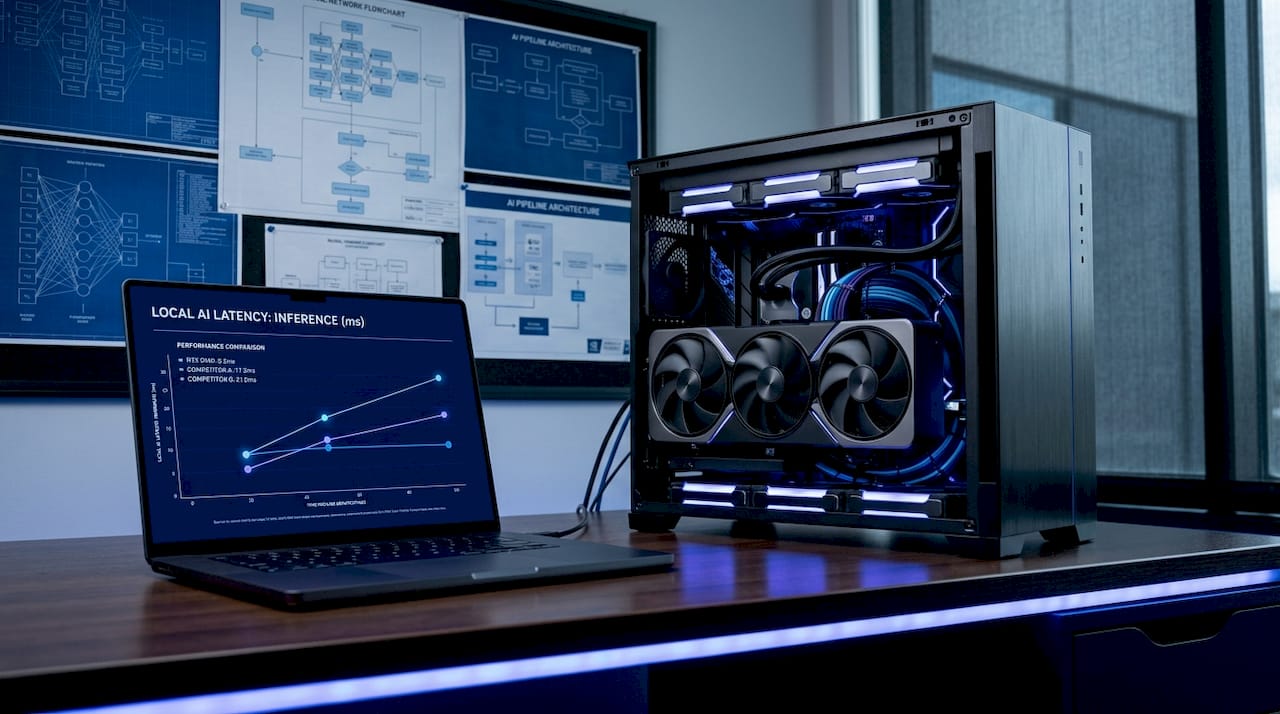
Benchmark data from RTX 5090 hardware running vLLM shows local throughput exceeding SaaS cloud inference on short, frequent requests. This makes local AI the clear choice for scenarios where the AI must respond within a conversational turn. However, the picture changes for long-form generation tasks. Local AI excels on latency for short, frequent interactions, while cloud AI can still lead on throughput for longer generative outputs because large SaaS providers run clusters of A100 and H100 GPUs that no single local workstation can match.
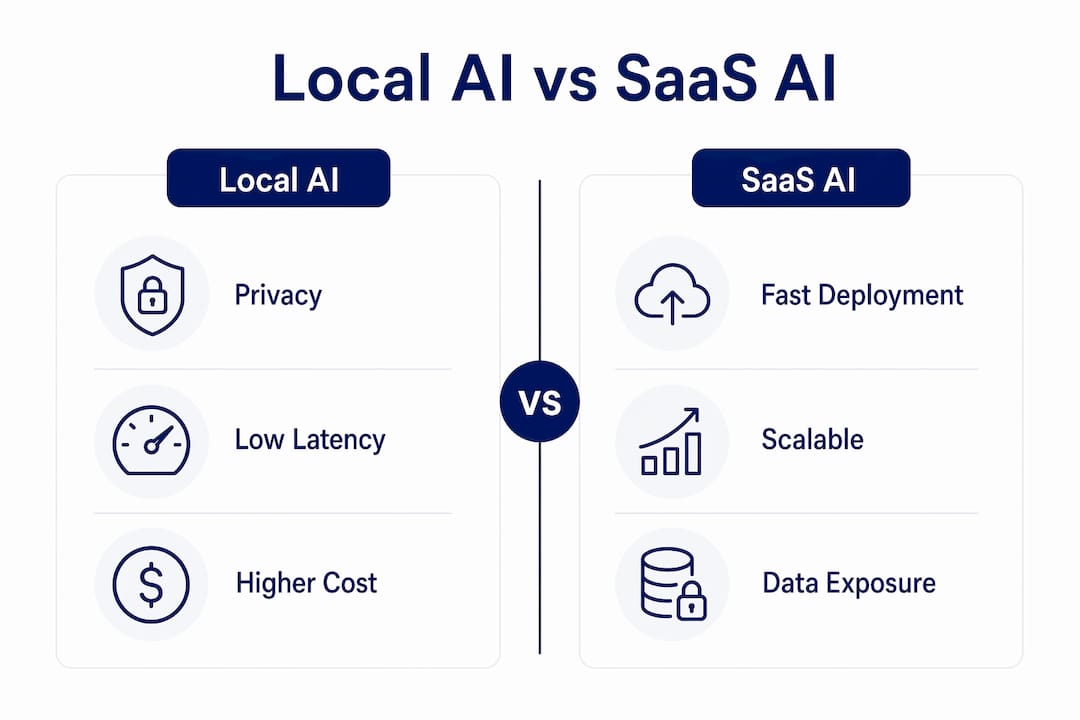
| Scenario | Local AI | SaaS AI |
|---|---|---|
| Short interactive responses | Sub-10ms TTFT, no network overhead | 50-200ms added latency per call |
| Long document generation | Limited by single GPU VRAM | Higher throughput via multi-GPU clusters |
| Real-time voice agents | Preferred, low jitter | Possible but latency-sensitive |
| Batch processing at scale | Constrained by local hardware | Scales horizontally on demand |
Pro Tip: For agentic workflows with tight loops, such as a voice assistant calling tools 10 to 20 times per task, local inference can save 1 to 4 seconds of accumulated latency per interaction. Profile your call frequency before assuming SaaS latency is acceptable.
What are the cost considerations and economics of local AI versus SaaS AI?
Cost structures for local and SaaS AI are fundamentally different, and the break-even point is more reachable than most teams expect. SaaS AI costs scale with token usage, with a representative example being roughly $50 per day for 10 million tokens, while local server hardware amortizes at approximately $15,000 to $20,000 over three or more years. At 5 million or more tokens per day, local hardware pays for itself within months.
The economics favor SaaS AI for low-volume or experimental workloads. A team running a prototype or processing under 500,000 tokens per day has no justification for capital hardware investment. SaaS platforms like Azure OpenAI Service and Amazon Bedrock offer pay-per-token pricing with no upfront commitment, which is the right model for early-stage AI integration.
Local AI changes the math at scale. Once inference volume crosses the break-even threshold, idle costs of always-on agentic loops become bounded by fixed hardware costs rather than accumulating per-token SaaS billing. A local server running 24 hours a day costs the same whether it processes 1 million or 10 million tokens. That predictability matters for budgeting AI-heavy products.
Additional cost factors to weigh before committing to local deployment:
- Electricity and cooling costs for always-on GPU servers (typically $200 to $500 per month for a single workstation)
- MLOps engineering time for model updates, hardware maintenance, and compliance auditing
- Recurring operational lifecycle costs for model refresh and hardware replacement cycles
- Opportunity cost of engineering time spent on infrastructure instead of product
Hybrid architectures reduce these costs by routing only high-volume or latency-sensitive tasks locally, while keeping SaaS for variable or complex workloads. For teams exploring AI strategies for SaaS growth, the hybrid model often delivers the best unit economics.
What are the automation and operational differences in deploying local AI versus SaaS AI?
Deployment speed is where SaaS AI wins decisively. SaaS AI delivers time-to-value in days, requiring only API key provisioning and endpoint configuration, while local AI deployments can take weeks to months depending on hardware procurement, model selection, and MLOps setup. For teams that need to ship AI features quickly, SaaS is the rational starting point.
Local AI deployment requires a different operational discipline. You own the full stack: hardware provisioning, model downloads, serving infrastructure (vLLM, Ollama, or similar), monitoring, and update cycles. That ownership creates flexibility but also imposes ongoing maintenance obligations. A local deployment is not a one-time setup. It is a living system that requires regular attention.
Here is a practical sequence for evaluating your operational readiness for local AI:
- Assess your team’s MLOps capability. Do you have engineers who can manage model serving infrastructure, debug GPU memory issues, and handle model version upgrades?
- Inventory your hardware. Local AI requires modern GPU hardware. An RTX 4090 or Apple M-series chip handles 7B to 14B parameter models well. Larger models need more VRAM or multi-GPU setups.
- Define your compliance governance model. Local AI gives you control, but you must exercise it. Audit logs, access controls, and model provenance tracking become your responsibility.
- Plan your orchestration layer. Tools like LangSmith and similar platforms can monitor both local and cloud inference, giving you unified observability across a hybrid stack.
- Establish a model refresh cadence. SaaS vendors manage compliance baselines automatically. Local deployments require you to track model updates and apply them on schedule.
One underappreciated advantage of local AI stacks is API compatibility. Ollama’s localhost REST API mirrors OpenAI’s endpoint format, which means you can swap local inference into existing automation pipelines by changing a single endpoint URL without re-architecting business logic.
What hybrid architectures combine local and SaaS AI for optimal deployment?
Hybrid AI architectures are the dominant pattern for production deployments in 2026 because they let you optimize each dimension independently. Hybrid and local-first architectures can reduce cloud inference calls by 70 to 80%, cutting costs by 50 to 100 times for tasks handled locally. That is not a marginal improvement. It is a structural cost reduction that changes the economics of AI-heavy products.
The core mechanism is an intelligent routing layer that classifies each inference request and directs it to the appropriate tier. Simple classification tasks, intent detection, and short-context completions go to quantized local 7B to 14B models. Complex reasoning, long-context synthesis, and low-confidence cases route to cloud models like GPT-4o or Claude 3.5 Sonnet. Hybrid architectures with tiered inference optimize cost, privacy, and availability while reducing dependency on any single cloud provider.
Practical hybrid deployment patterns worth considering:
- Confidence cascading: The local model attempts the task first. If its confidence score falls below a threshold, the request escalates to a cloud model automatically.
- Task-type classification: A lightweight classifier routes requests by category. Document summarization goes local. Multi-step reasoning goes cloud.
- Data sensitivity routing: Any request containing PII, financial data, or regulated content routes to local inference regardless of task complexity.
- Cost-ceiling routing: When daily SaaS spend approaches a budget threshold, overflow traffic routes to local capacity.
For teams building on top of data infrastructure, scaling AI analytics infrastructure with hybrid routing layers is increasingly the standard approach for balancing performance and governance.
Key takeaways
Local AI and SaaS AI require different infrastructure, cost models, and compliance postures, and the best deployments in 2026 combine both through intelligent routing.
| Point | Details |
|---|---|
| Privacy is about inference location | Local AI keeps prompts on your hardware; SaaS AI may log inference data on vendor servers. |
| Latency favors local for real-time use | Local GPU inference delivers sub-10ms TTFT versus 50-200ms for cloud API calls. |
| Cost break-even is volume-dependent | Local hardware pays off at roughly 5M+ tokens per day; SaaS wins for low-volume workloads. |
| SaaS deploys faster | SaaS AI reaches production in days; local AI deployments require weeks to months of MLOps work. |
| Hybrid routing cuts cloud costs sharply | Routing simpler tasks locally can reduce cloud inference calls by 70 to 80 percent. |
Why I think most teams are choosing the wrong deployment model
Most teams default to SaaS AI because it is fast to start, and that is a reasonable choice for prototyping. The mistake is treating that starting point as a permanent architecture. I have watched engineering teams accumulate $40,000 to $80,000 per year in SaaS inference costs for workloads that a single local server could handle at a fraction of that, simply because no one paused to run the numbers.
The teams that get this right are the ones who separate the question of where to start from where to run at scale. Start with SaaS. Measure your token volume. When you cross the break-even threshold, move high-frequency, low-complexity tasks to local inference and keep SaaS for the cases where it genuinely outperforms. That is not a controversial position. It is just math.
The compliance angle is where I see the most underestimation. Teams building for healthcare, legal, or financial services often assume that enterprise SaaS tiers solve their data residency requirements. Sometimes they do. But the EU AI Act and evolving GDPR enforcement are tightening the definition of what counts as adequate data control. Local inference is the only architecture that gives you a provably clean answer to a regulator asking where your data went.
The technology is mature enough in 2026 that local AI is no longer an enthusiast project. Ollama, vLLM, and Apple Silicon have made local inference accessible to any team with a modern workstation. The question is not whether you can run locally. It is whether you have thought carefully enough about when you should.
— steve
Run AI on your own terms with Mingllm
If the case for local AI resonates with your privacy, latency, or cost requirements, Mingllm is built precisely for this use case. Mingllm runs entirely on your device, with models, memory, and reasoning processes executing on your hardware. No vendor logging. No per-token billing. No data leaving your machine. The platform integrates voice interaction, browser-based research, and native macOS app control into a single local-first AI system. For power users and privacy-conscious teams who want deep device integration without cloud dependency, explore Mingllm and see what personal superintelligence running locally actually feels like in practice.
FAQ
What is local AI, exactly?
Local AI is AI inference that runs on hardware you own and control, such as a personal workstation, on-premises server, or edge device. No data is sent to external servers during inference.
When does SaaS AI make more sense than local AI?
SaaS AI is the better choice for low-volume workloads, rapid prototyping, and teams without MLOps capacity. It deploys in days and requires no upfront hardware investment.
How does local AI affect GDPR and EU AI Act compliance?
Local inference keeps data within your controlled infrastructure, eliminating third-party data exposure. This gives you a cleaner compliance posture under GDPR data residency requirements and EU AI Act obligations.
What is a hybrid AI architecture?
A hybrid AI architecture routes inference requests between local models and cloud APIs based on task complexity, data sensitivity, or cost thresholds. It reduces cloud inference calls by 70 to 80 percent for tasks handled locally.
Can local AI integrate with existing automation pipelines?
Yes. Tools like Ollama expose a localhost REST API that mirrors the OpenAI endpoint format, allowing you to swap local inference into existing workflows by changing a single endpoint URL.