What Is an AI Governance Framework? 2026 Guide

Most professionals assume AI governance is a compliance exercise handled by legal teams. It is not. An AI governance framework is the operational architecture that determines whether your organization can deploy AI responsibly, at scale, and without creating liability you can’t see coming. Understanding what is an AI governance framework matters because the gap between deploying AI and governing it is where regulatory penalties, reputational damage, and ethical failures actually live. This guide covers the definition, core principles, implementation steps, and strategic value that professionals and policymakers need to act on now.
Table of Contents
- Key takeaways
- What is an AI governance framework, exactly
- Core AI governance principles and global standards
- How to implement AI governance in your organization
- Governing advanced AI systems and agentic frameworks
- The strategic value of AI governance beyond compliance
- My take: governance fails when it’s treated as a destination
- Put responsible AI governance into practice with Mingllm
- FAQ
Key takeaways
| Point | Details |
|---|---|
| Governance is a blueprint | An AI governance framework defines policies, processes, and controls across the full AI lifecycle. |
| Principles ground every framework | Inclusion, transparency, accountability, and robustness are the five pillars recognized globally. |
| Risk tiers prevent friction | Mapping AI systems to risk levels lets you apply controls proportionate to actual impact. |
| Governance is continuous | Model drift and integration changes require real-time monitoring, not annual reviews. |
| Strategic value exceeds compliance | Effective governance builds stakeholder trust and enables faster, safer AI adoption at scale. |
What is an AI governance framework, exactly
An AI governance framework is a comprehensive blueprint of policies, processes, and controls that ensures responsible management of AI systems across their full lifecycle. That lifecycle runs from initial discovery and risk assessment through deployment, monitoring, and eventual decommissioning. The framework aligns AI usage with business objectives, legal requirements, and your organization’s risk tolerance. It is not just documentation. It is the connective tissue between strategy and execution.
People often confuse AI governance with data governance. Data governance focuses on how information is classified, stored, accessed, and protected. AI governance covers a larger surface: how AI systems are built, trained, deployed, monitored, and retired. Both are necessary, but they answer different questions.
A well-structured framework includes five core components:
- Accountability: Clear ownership of AI systems and the decisions they influence
- Transparency: Documented model logic, training data provenance, and decision rationale
- Risk management: Tiered assessment of AI applications by potential harm
- Security: Access controls, model integrity checks, and protection against adversarial inputs
- Monitoring: Continuous performance tracking to detect drift, bias, and policy violations
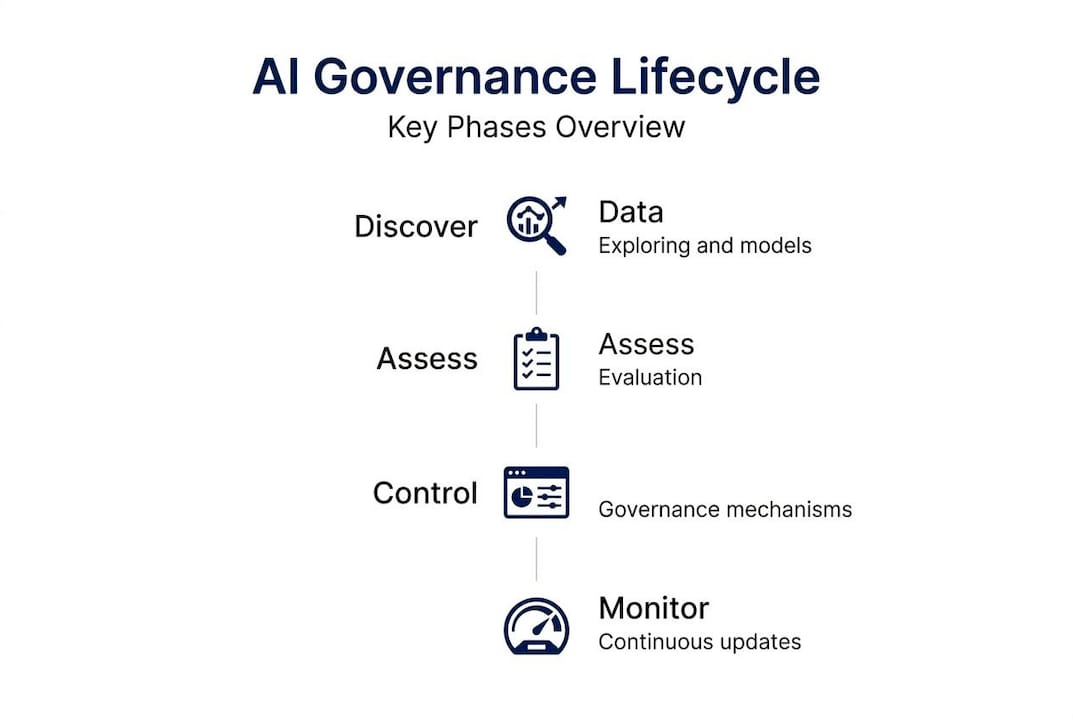
The lifecycle moves through four phases. First, you discover what AI systems exist in your environment. Second, you assess each system’s risk profile. Third, you apply controls proportionate to that risk. Fourth, you monitor continuously. Organizations that skip the discovery phase routinely find they are governing only the AI they know about, while dozens of unapproved tools operate in the shadows.
Core AI governance principles and global standards
The five foundational AI governance principles recognized globally are inclusion, human-centered values, transparency, robustness and security, and accountability. These are not abstract ideals. They are operational commitments that must translate into specific policies.

The OECD Principles on AI have been adopted by 49 countries as the closest thing to a universal baseline. Their emphasis on inclusive growth and human-centered AI design gives policymakers a shared vocabulary when negotiating cross-border deployments. For organizations operating across multiple jurisdictions, alignment with OECD principles reduces the risk of conflicting regulatory obligations.
Two frameworks translate these principles into operational structures most effectively:
| Framework | Type | Primary focus | Certifiable |
|---|---|---|---|
| NIST AI RMF | Voluntary | Risk management and organizational strategy | No |
| ISO/IEC 42001 | Standard | AI management system requirements | Yes |
| EU AI Act | Regulation | Risk-based tier classification | Mandatory (EU) |
| OECD AI Principles | Guideline | Foundational ethical principles | No |
The NIST AI Risk Management Framework links governance to corporate strategy and requires cross-functional coordination with executive sponsorship. It frames governance as a strategic advantage rather than a compliance burden. ISO/IEC 42001 takes it further by establishing requirements that organizations can be certified against, which matters when you are procuring AI systems from third-party vendors.
The EU AI Act introduces a risk-tier approach. High-risk categories such as hiring systems, credit scoring, and biometric identification face mandatory conformity assessments. Low-risk applications like spam filters face minimal requirements. This tiered logic should inform your internal governance architecture regardless of whether your organization operates in the EU.
Pro Tip: Align your internal risk tiers with the EU AI Act’s categories from day one, even if you operate outside the EU. Global customers and partners will increasingly expect this alignment, and retrofitting governance to meet it later costs far more than building it in up front.
How to implement AI governance in your organization
Implementation fails most often because organizations treat governance as a project with a finish line. It is a function with no finish line. Here is how to build it correctly from the start.
-
Form a cross-functional governance committee. Include representatives from legal, IT security, data science, HR, and business operations. AI governance cannot live in compliance or IT alone. The decisions it covers touch every function.
-
Inventory your AI systems. You cannot govern what you cannot see. Conduct a full audit of AI tools in use across the organization, including SaaS integrations that embed AI features without explicit procurement decisions. “Shadow AI” creates exactly the compliance gaps that regulators penalize.
-
Map each system to a risk tier. Differentiating by risk tier prevents overburdening low-risk tools while ensuring high-risk systems receive proportionate controls. A chatbot handling internal FAQs needs different oversight than a model making loan approval recommendations.
-
Implement access controls and monitoring. Define who can deploy, modify, or decommission AI systems. Set up real-time monitoring dashboards that flag anomalous behavior, model drift, and permission changes immediately.
-
Establish a continuous review cadence. Continuous monitoring replaces annual reviews because model drift, permission changes, and integration updates create risks that appear between scheduled audits. Build review triggers tied to specific events: model updates, new integrations, regulatory changes.
-
Document and test your policies. Written policies only work if they are enforced. Build automated testing into your AI deployment pipeline to verify that governance controls are active before a model goes live.
Pro Tip: When onboarding a new AI vendor, require them to complete a governance questionnaire that maps their system to your risk tier criteria before procurement approval. Most organizations check security but skip governance alignment entirely.
One challenge that catches organizations off guard is integration drift in SaaS environments. A productivity tool you approved six months ago may have added new AI features in its latest update. Those features now operate inside your environment without any governance review. Assign ownership for tracking vendor AI feature updates as part of your governance function.
Governing advanced AI systems and agentic frameworks
Not all AI systems need the same governance architecture. A spell checker and an AI system that autonomously executes financial transactions are categorically different governance problems. Treating them the same creates friction where you don’t need it and blind spots where you do.
High-risk decision systems in hiring, healthcare, credit, and law enforcement require the most rigorous controls. These systems influence outcomes that are difficult to reverse and disproportionately affect vulnerable populations. Governance here must include explainability requirements, bias audits, human review checkpoints, and documented appeal processes.
Singapore’s Model AI Governance Framework for agentic AI systems provides the clearest technical architecture for autonomous AI. It embeds controls throughout the agent lifecycle:
- Policy decision points: Evaluate every proposed action against governance rules before execution
- Approval gates: Require human or automated sign-off for high-impact actions
- Execution gateways: Enforce constraints at the point of action, not retrospectively
- Oversight layers: Log all actions with context for post-event review
Audit trails must capture the full chain of AI decisions including the user request, agent version, policy rules applied, and post-action evaluation. This enables accountability and allows debugging in regulated environments. Organizations that rely only on post-deployment audits are already behind. Technical enforcement must precede deployment.
Continuous compliance testing is equally critical. Automated policy testing against scenarios including prompt injection and misuse attempts is necessary because AI deployment velocity outpaces what manual audits can realistically cover.
The strategic value of AI governance beyond compliance
Here is the framing shift that separates organizations doing governance well from those treating it as overhead: governance is not a cost center. Effective governance frameworks increase trust, reduce risk, and enable faster, safer AI adoption at scale.
Boards are changing their role. Executives are now expected to understand AI governance at a strategic level, not delegate it entirely to technical teams. The emergence of board-level AI governance principles reflects recognition that AI risk is enterprise risk. It belongs in the same conversations as financial risk and reputational risk.
“Market incentives alone do not produce accountable AI. Prioritizing engagement and scale without governance mechanisms creates social harm that organizations pay for later in regulation, litigation, and lost trust.”
The competitive advantage argument is concrete. Organizations with mature governance frameworks move faster when deploying new AI applications because the review and approval process is defined, not invented each time. They also attract enterprise customers who require vendor governance documentation as part of procurement. Governance matures from gatekeeper to enabler when it is built into operations rather than bolted on afterward.
For tools that operate across biometric tech assessments and other sensitive AI applications, governance frameworks determine whether those tools can be deployed at all in regulated industries.
Pro Tip: Present your AI governance framework to your board using the language of risk and competitive differentiation, not compliance. Boards respond to value and liability. Frame governance as the mechanism that protects both.
My take: governance fails when it’s treated as a destination
I’ve watched organizations build governance frameworks with real care and then watch them collapse within 18 months. Not because the framework was wrong. Because it was treated as a project that got completed, rather than a function that runs continuously.
What I’ve learned from working through these problems is that the organizations with the strongest governance do one thing differently: they make it impossible to deploy AI without passing through governance checkpoints. The controls are technical, not procedural. You cannot submit a pull request that bypasses the policy engine. You cannot onboard a new SaaS tool without a governance review triggering automatically.
The other pattern I keep seeing is governance siloed in one team. Compliance owns the policies. IT owns the monitoring. Data science owns the models. Nobody owns the integration between them. That gap is where most failures actually occur.
Risk-tier differentiation is genuinely one of the most underused tools in governance design. When you apply the same scrutiny to a calendar scheduling assistant that you apply to a credit scoring model, you exhaust your governance capacity on low-stakes decisions and leave high-stakes systems under-reviewed. The teams pushing back on governance hardest are almost always dealing with disproportionate controls on low-risk tools.
The future of this field belongs to organizations that treat governance as evidence-based, continuous, and technically enforced. Not as a policy document reviewed once a year.
— steve
Put responsible AI governance into practice with Mingllm
Understanding the principles of an AI governance framework is the first step. Operationalizing them on your own hardware is where Mingllm delivers.

Mingllm runs entirely locally on your device, which means the transparency, accountability, and control your governance framework demands are built into the architecture by default. Every action is logged with proof traces. Every reasoning process stays on your hardware. No data leaves your environment without your explicit control. For professionals and policymakers who need to demonstrate governance compliance without sacrificing capability, Mingllm provides the kind of local AI control that enterprise governance frameworks increasingly require. Explore what responsible, local AI looks like in practice.
FAQ
What is an AI governance framework?
An AI governance framework is a structured set of policies, processes, and controls that guide how AI systems are developed, deployed, monitored, and retired within an organization. It aligns AI usage with legal requirements, ethical standards, and business objectives.
Why does AI governance matter for organizations?
Without governance, organizations lack accountability mechanisms for AI decisions, creating legal, ethical, and reputational risk. Governance frameworks reduce those risks while enabling faster and more trustworthy AI adoption at scale.
What are the core AI governance principles?
The five core principles are inclusion, human-centered values, transparency, robustness and security, and accountability. These are formalized in the OECD AI Principles, adopted by 49 countries as a global baseline.
How is AI governance different from data governance?
Data governance covers how data is classified, stored, and protected. AI governance covers a broader scope including how AI models are built, trained, tested, deployed, monitored, and decommissioned, with specific focus on accountability and risk management.
What are the biggest challenges in implementing AI governance?
The most common challenges are discovering shadow AI in SaaS environments, preventing integration drift, enforcing policies at the speed of AI adoption, and avoiding the mistake of treating governance as a one-time compliance exercise rather than a continuous operational function.