What is an AI world model: a developer’s guide

Most developers who work with AI daily carry a quiet misconception: that a world model is just another name for a large foundation model. It is not. An AI world model is a fundamentally different architecture, one that predicts action-conditioned environment dynamics rather than the next token in a sequence. Understanding this distinction matters enormously if you are building systems that interact with the physical world, automate tasks on a device, or need AI that can reason about consequences before taking action. This guide breaks down the architecture, significance, and practical applications of AI world models with the specificity developers actually need.
Table of Contents
- Understanding what an AI world model is
- How AI world models work: the three-component architecture
- Why AI world models matter: from seeing text to simulating reality
- Applications and implications of AI world models for developers and macOS users
- Rethinking AI intelligence: the future shaped by world models
- Unlock your AI’s potential with MingLLM on macOS
- Frequently asked questions
Key Takeaways
| Point | Details |
|---|---|
| World models predict environment states | They model future physical or simulated world states based on current data and actions, unlike language models that predict next words. |
| Three-component architecture | World models compress observations to latent states, predict next latent states with dynamics models, and decode predictions for interpretation. |
| Simulation enables foresight | By simulating realities and consequences, world models allow AI to plan and reason, offering deeper situational awareness than text prediction. |
| Practical relevance for local AI | Efficient latent computation and action-aware prediction enable privacy-friendly and powerful AI experiences on devices like macOS. |
| Future-facing AI intelligence | World models mark a shift from prediction to understanding causality, essential for trustworthy, interactive, and embodied AI systems. |
Understanding what an AI world model is
The cleanest definition: a world model is a predictive system that learns an internal representation of an environment and uses it to forecast future states based on current state plus action. Not next word. Next state of the world.

That single distinction separates world models from large language models (LLMs) at a conceptual level. An LLM trained on text learns which token follows which. It has no mechanism for understanding that pushing a glass toward an edge means it falls. A world model, by contrast, predicts future states from actions, building an internal causal map of how the environment behaves. This is the core of AI world modeling concepts.
Here is what separates them in practice:
- Prediction target: LLMs predict the next word. World models predict the next environment state given an action.
- Grounding: LLMs operate in token space. World models operate in physical or simulated space.
- Planning capability: LLMs can narrate a plan. World models can simulate one, including its failure modes.
- Reasoning type: LLMs pattern-match across text. World models reason causally about consequences.
- Primary use case: LLMs excel at language tasks. World models power robotics, autonomous agents, and simulation-based automation.
For developers building AI applications that need to interact with the world rather than just describe it, understanding AI world models is the prerequisite for designing systems that actually work reliably outside of chat interfaces.
How AI world models work: the three-component architecture
Once you understand what a world model is trying to do, the architecture makes intuitive sense. The system needs to take in messy sensory input, compress it into something manageable, simulate what happens next given an action, and then translate that prediction back into something interpretable.
That is exactly the three-stage pipeline world models use:
- Encoder: Takes raw sensory input (pixels, sensor readings, system state) and compresses it into a compact latent representation. Think of this as building a mental sketch of the current situation rather than holding every pixel in memory.
- Dynamics model: Given the current latent state and a proposed action, predicts the next latent state. This is the core predictive engine. It learns the physics and logic of the environment purely from observed data.
- Decoder: Reconstructs a human-interpretable prediction from the latent state, whether that means generating a visual frame, a system status, or a behavioral output.
The latent space compression is what makes world models computationally tractable. Instead of predicting changes across thousands of pixels, the dynamics model operates in a much smaller, structured representation. Each forward pass costs a fixed amount of compute regardless of environment complexity, which is why the latent space architecture is so valuable for local, on-device computation.
| Component | Input | Output | Core function |
|---|---|---|---|
| Encoder | Raw sensory data | Latent state vector | Compression and representation |
| Dynamics model | Latent state + action | Next latent state | Causal prediction |
| Decoder | Latent state | Interpretable output | Reconstruction for use |
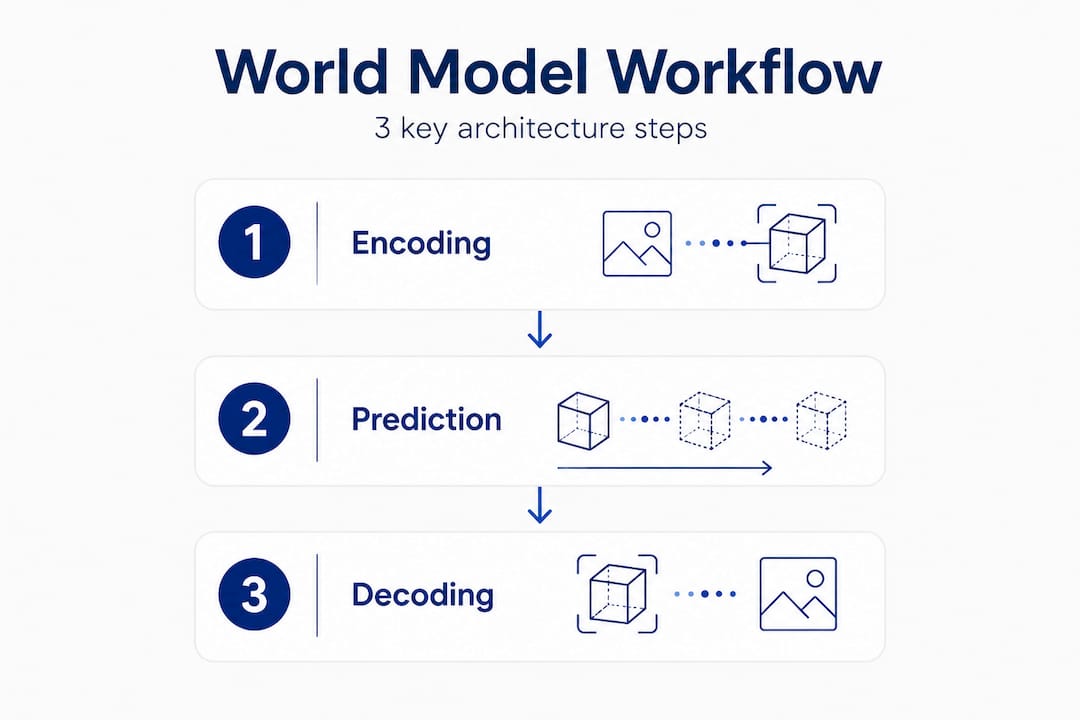
One critical nuance is that the dynamics model is action-conditioned. It does not just predict what happens next in general. It predicts what happens if this specific action is taken. That conditionality is what enables planning: you can unroll multiple hypothetical action sequences in latent space and evaluate which one leads to the best outcome before committing to any real-world action.
Pro Tip: If you are building a world model for multi-step planning, rollout consistency is your biggest engineering challenge. Errors compound across prediction steps. Prioritize training for stable latent trajectories over high single-step accuracy, especially for tasks requiring more than three or four decision steps ahead.
Why AI world models matter: from seeing text to simulating reality
There is a structural limit to what text prediction can do for you when you need an AI agent to act reliably in the world. LLMs can describe what should happen. World models can simulate what will happen given a specific action sequence. That gap is enormous in practice.
The importance of AI world models becomes clearest when you consider what planning actually requires. To plan well, an AI needs to mentally test multiple futures and evaluate consequences before acting. LLMs do not do this natively. They generate plausible next tokens, which can look like reasoning but is not the same as causal simulation.
“World models allow AI to simulate reality and test consequences before acting, providing situational awareness that LLMs lack, crucial for reliable decisions in robotics and complex workflows.” — Goldman Sachs
That situational awareness unlocks several capabilities that text prediction simply cannot replicate:
- Consequence testing: Evaluate an action’s downstream effects without executing it in the real world.
- Physical world reasoning: Model the behavior of objects, forces, and environments under different conditions.
- Social dynamics simulation: Predict how other agents, human or AI, will respond to a given action.
- Safer agent training: Train AI agents in simulated environments where failure carries no real cost.
- Foresight in automation: Enable automation pipelines that can anticipate edge cases rather than only reacting to them.
For any developer building task automation that touches the real world, whether it is a macOS agent executing multi-step workflows or a system integrating with hardware, this predictive capacity is not a nice-to-have. It is the difference between automation that handles edge cases gracefully and automation that breaks the moment conditions deviate from the training distribution.
Applications and implications of AI world models for developers and macOS users
The applications of AI world models land in two broad categories: robotics and physical systems, and local intelligent agents. Both are highly relevant for developers building privacy-focused, on-device AI.
In robotics, world models enable fast training of AI agents inside virtual environments built from video and sensor data. Instead of requiring months of real-world trial and error, a robot can run millions of simulated episodes in compressed time, learning physics and task structure before touching physical hardware. That simulation capacity is now moving into software agents and desktop automation as well.
For macOS developers and power users, the relevance is more immediate:
- Predictive task execution: An agent with a world model can simulate whether a multi-step task will succeed before running it, reducing errors in automated workflows.
- Local efficiency: Because world models operate in compressed latent space, they are computationally lighter than running full generative models for every decision step.
- Privacy by design: Local computation of the dynamics model means sensitive context never needs to leave the device.
- Reversible action planning: Simulating consequences before execution supports the kind of reversible, auditable action logs that privacy-focused systems require.
Here is how traditional AI agents compare to world-model-powered agents in the context of personal AI integration:
| Capability | Traditional AI agent | World model agent |
|---|---|---|
| Multi-step planning | Prompt-chained, fragile | Simulated in latent space, robust |
| Error anticipation | Reactive | Proactive consequence testing |
| Compute model | Repeated large inference calls | Efficient latent dynamics passes |
| Privacy | Often cloud-dependent | Local simulation possible |
| Physical world reasoning | None | Native capability |
| Failure handling | Usually requires retry logic | Can evaluate failure paths before acting |
Pro Tip: If you are integrating AI into a macOS automation pipeline, prioritize architectures that keep the dynamics model local. Cloud-dependent planning loops introduce latency and privacy exposure at the exact point where your agent is making consequential decisions. Keeping inference local changes the privacy calculus completely.
Rethinking AI intelligence: the future shaped by world models
Here is a view worth sitting with. The AI industry spent the last five years treating language fluency as a proxy for intelligence. The assumption was: if a model can write convincingly about surgery, it probably understands surgery well enough to help with it. World models reveal exactly how fragile that assumption is.
Intelligence is fundamentally about navigating structured realities, not generating plausible outputs. A system that can simulate the consequences of its actions, test hypotheses in a mental model of the world, and update that model when reality diverges is doing something qualitatively different from autocompletion at scale. That is the shift world models represent.
What concerns me, having watched this space closely, is how many developers are still building on top of pure LLM stacks for tasks that require genuine situational awareness. The text interface hides the limitation well enough that it is easy to rationalize. Until your automation agent deletes the wrong file because it had no mechanism for simulating what “delete all old logs” would affect in the current directory state.
The push toward local, world-model-aware AI is not just about performance. It is about trustworthiness. An AI that can show you its simulated consequence trace before acting is one you can actually audit. That transparency is what turns an AI tool into an AI partner. For developers building personal AI systems on macOS, this matters now, not in some future product cycle.
The uncomfortable truth is that most “agentic AI” marketed today does not contain a world model in any meaningful sense. It contains a prompt-chained LLM with some tool access. That will work for simple, well-scoped tasks. For anything requiring multi-step planning in a dynamic environment, the architectural gap will surface as errors. Developers who understand AI world modeling concepts now will build more reliable systems than those who discover the limitation through production failures.
Unlock your AI’s potential with MingLLM on macOS
If the architecture of world models has you thinking about what local, privacy-first AI could look like in practice, MingLLM is built exactly for that. It runs entirely on your device, keeping all models, memory, and reasoning local. No cloud dependency. No data leaving your machine.

MingLLM brings world-model-inspired design to personal AI on macOS: a voice agent that executes tasks across native apps, a browser agent that synthesizes your open tabs with citations, and action logs that give you full transparency into what the system did and why. The architecture is built around reversible actions and proof traces, precisely the kind of auditable, consequence-aware design that world model principles demand. If you are a developer or power user who wants an AI that reasons about tasks before running them, MingLLM is where those principles become a daily workflow.
Frequently asked questions
What exactly distinguishes a world model from a large language model?
World models build internal representations of environments to predict future states given actions, while large language models predict the next token in a text sequence with no model of physical consequences. The distinction is causal simulation versus statistical pattern matching.
How do world models benefit AI systems that control robots?
They provide simulated environments where robots can test actions and learn from failure at scale before any real-world deployment, dramatically speeding up robot training while reducing physical risk.
Are world models computationally efficient enough for local AI applications?
Yes. Because they operate in compressed latent spaces rather than full sensory space, each prediction step costs a fixed, relatively small amount of compute, making them well-suited for on-device inference on modern hardware like Apple Silicon.
Can world models improve privacy for AI users on devices like macOS?
Local world model computation means the AI can reason and plan without sending data to external servers, which significantly reduces the privacy surface compared to cloud-dependent agent architectures.
What is the main challenge world models address compared to traditional AI?
Traditional AI recognizes patterns. World models simulate causality, giving AI the ability to reason about what an action will cause rather than just predicting what text typically follows a given prompt.